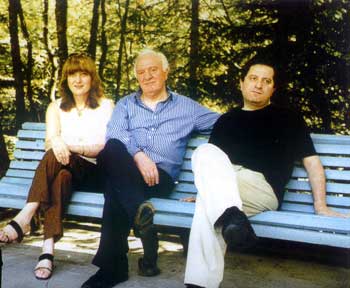
Manana Shevardnadze
Parent-child relationships are traditionally difficult - and particularly so for the child of Eduard Shevardnadze. What kind of a father is he?
Eduard Shevardnadze is a special father, a special husband, grandfather and... a special politician. Nothing about him can be considered ‘ordinary’. In our family and among our close relations, there is a ‘cult’ of my father. I have always tried to learn from him, follow his example, and care for him. I can think of no warmer or loving person. I remember when I was a little girl, every time my father came home, I would always run to greet him. He would smile at us from a distance. His remarkable smile has been a feature of my entire life. Since our childhood, he treated my brother and me as independent individuals. In general, he is very delicate in his relations with people and always treats others with respect.
Since childhood, I have been charmed by my parents vivacity. I was always
glad when other people complimented me on my good-looking, young parents.
To this day, I have the feeling that my parents are still the youngest
and the best-looking. Father has always been loyal and intuitive. He is
progressive in his approach to resolving any problem. Even today, he is
still far fresher in heart than many politicians much younger than he is.
What did being the child of Eduard Shevardnadze give you?
A lot. Most importantly, he taught me life. He has always been my source of strength. But many things were forbidden to me.

Didn’t you ever feel rebellious as a result?
Up to a certain age, both my brother and I did. But because of our love and respect for him, we tried to contain ourselves. My daughter was always protesting, though. Every summer, we went to Lidzava. The dacha where we stayed was on a compound, and Tako was always complaining that she didn’t want to remain on the ‘reservation’. “Let me go to an ordinary resort,” she would say. The grandfather and granddaughter, however, actually had a more delicate relationship than Father had with his children.
There were many fateful moments in the President’s life...
There were many things that required sacrifice. He has never betrayed his principles, whether it was over the fate of the Georgian language or the conflict in Abkhazia. I still shudder when I remember the days during the Moscow putsch. We got a call at seven o’clock in the morning telling us to turn on the television. I woke Father up, and we began to watch the horrible news. We learned that there were lists of those who were to be arrested, and my father’s name was number 3 on the list.
His friends came to help him hide, and I remember Father put on his leather jacket. When I looked at him, I was afraid I might never see him again. Soon, they showed him on television. My father was at the barricades in front of the White House, and the Russians were shouting with hope: “See - Shevardnadze is with us, too!”
He was very worried at that time about the developments in Georgia. Representatives of the Georgian intelligentsia came to Moscow and implored him to return. Father knew that this would not be a particularly advantageous political move. One evening he asked me “What shall I do, Mancho?” “You must go,” I said to him. And I felt as though I was sending him to be sacrificed. I remember once an American diplomat telling him, “What are you doing - you are born to sail in the ocean and you are choosing to swim in a pond.” “That pond is my homeland,” he replied.
I will never forget when he returned from Abkhazia. It was the first time I had ever seen him so disheveled. He was wearing a strange sweater, and collapsed in a chair. “A tank ran over my suitcase, and my notes were in there,” he said, dejected.
What can you say about your father as a politician?
Even under pressure he is very sincere, and this has been a great advantage to him. This is because he creates honesty in politics. This is why he often wins out. It is said that politics is dirty. Well, it depends on the politician.
My father has always been a strong leader with a unique synthesis of hard work and talent. He is an extremely strong person, unlike anyone else I know. History will record him as a singular politician. Father’s life is completely absorbed in the national interests. I believe that the return of Abkhazia is the ultimate goal of his life, and that he will succeed. What is most important is that it has nothing to do with his ‘career.’ There is no greater career for him than Georgia. He made his choice in Moscow, and that choice was Georgia.
Mshvidoba Kovelta. 25 January, 1998