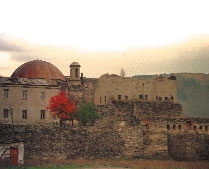
Samtskhe-Djavakheti, a mountainous and gorgeous land, famed for its exquisite fruit and agreeable climate is the pride and joy of our history.
A century ago, "Iveria", a popular Georgian newspaper wrote: " Samtskhe-Djavakheti, the southern part of Georgia, historically called Samtskhe Saatabago, has always stood as a rock-fortress, successfully defending the country from numerous invaders." Saint Nino of Cabadocia, the first Christian preacher in Georgia, entered the country with a holy cross made of vine stems tied by her own hair via the misty mountains of Djavakheti. This is also the oldest dwelling place for Georgians. Meskheti was the common name for the whole territory of the Upper Kartli region and embraced a number of former Georgian provinces, which as a consequence of wars became part of Turkey.
From early days this land has been blessed as a holy place. During the Middle Ages Samtskhe-Djavakheti and the Meskhian people revived the spiritual life and religious studies in this part of Georgia. In Samtskhe Saatabago alone thirteen Episcopal Congregations existed.
Samtskhe-Djavakheti starts at the "Paravani" lake and extends along the mountain range. Lofty and gorgeous mountains, their tops veiled in blue mist stand like a solid fortress and guard this beautiful region, where the visitors can still hear the whispering of the bygone centuries... The same mountains served as obstacles and complicated combat for invaders. But the enemies were numerous and fierce; every year, with the melting of the snow hordes of Ottoman Turks and Persian troops steadily advanced towards Samtskhe to conquer, devastate and plunder...
Invasions and onslaughts have never been a novelty to Georgian provinces, but Samtskhe-Djavakheti has suffered the most. The majority of the population had to give up their Christian faith, although the historians and travellers show in their works, that people of this land have maintained the Georgian language together with native traditions and habits to the present day.
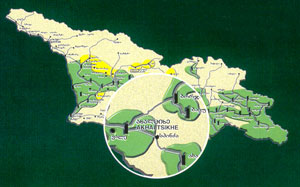
The whole region of Samtske-Djavakheti constitutes one great museum; each time people visit it, they marvel at the rediscovered wonders. Of particular interest is the ancient capital Akhaltsikhe, mentioned in Georgian annals from XII century. It was a fortified town, built on a rock, its name Akhaltsikhe meaning "the New Fortress" in English.
Because of its favourable geographic location this town served as an important trade centre throughout the Anterior Asia. Nature itself appeared to favour the merchants’ activities ; winter in Samtskhe-Djavakheti usually proves cold, but there is seldom too much snow; summers are long and warm... This land is abundant in water as well and the majority of Georgian lakes originate in the Djavakheti district. The biggest, Paravani Lake, has served as the source of inspiration for many romantic legends.
The Mtkvari, irrigates parts of this district. The Potskhovi,
Kvabliani and Uraveli rivers flow in other places of the land, making the
harvest especially rich in this region. Apples and pears taste especially
good; one type of apples, the Abilauri, received the Golden Medal
at the 1912 Paris Exhibition.
The writings of the chronicler Prokopi Kesarieli state that the Meskhetians
"grow many vineyards and even trade their wine in foreign countries". The
unique Georgian grape varieties, such as Tita, Saperavi, Kharistvala produced
wonderful wine in ancient Meskhetian stone-carved wine-presses and this
wine-making process was usually accompanied by the polyphonic Georgian
folk song Mravaljamieri.
All visitors to the Samtskhe-Javakheti region receive generous servings of various sweets. These deserts are made from mulberry juice, a speciality of the place. A unique mulberry liquor accompanies these delicacies and makes the heavenly sensation complete.
Tourists can enjoy a delightful holiday by taking advantage of the healing
thermal baths, the most renowned of which are Aspindza, Akhaltsikhe and
Uraveli waters.
The Meskhetians take pride in their bold and courageous ferrymen. In
the past, operating ferries was a popular and exotic occupation. The tradition
of putting poems to music comes down from the ferrymen and it spread throughout
the entire region of Samtskhe-Djavakheti. In olden days the sweet singing
of these bards could be heard echoing by the unparalleled monuments of
architecture.
Rabati, the old part of Akhaltsikhe has ancient dwelling halls called "Darbazi" in Georgian and the remnants of a Bronze Age village nearby prove memorable. Moreover, the whole region of Samtskhe-Djavakheti is an architectural complex. The Sapara Monastery, which was once the residence of the Samtskhe landlords, is surrounded by the domed church of St. Saba, the Church of Assumption and a small chapel of St. Dimitri. Not a single column or a window arc in these buildings lacks ornamentation...
The walls of Atskuri Fortress leave the impression of a natural extension
of the rocks. The nearby Meskhetian terraces are another wonder;
these mystical rocky stairs create the image of ascending into heavens...
Struggling with stone and fighting the rocks is one more manifestation
of the power of Meskhetian character.
Thoughts, which occur in the course of travelling in this huge open
air museum take visitors back to the early Middle Ages. The magnificent
and stern Tmogvi Castle built upon a steep rock on the left side of the
Mtkvari River, overlooking the beautiful Tsunda Lake invokes this earlier
period.
The Meskhetian Georgians still have much to be proud of, even if they
only have Vardzia to boast about. This holy town commands awe and veneration
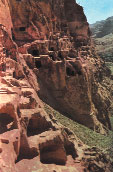
from each and every Georgian, as well as from foreign visitors. Vardzia,
a thirteen storied cave-town stretches over an area of half a kilometre.
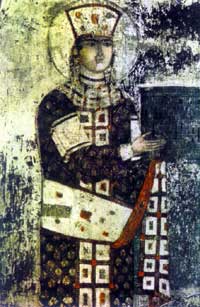
In one of the caves one may see the icon of Queen Tamar which has been
preserved for generations; a Persian Chronicler wrote about this remarkable
cave town: "Vardzia is a real wonder, resembling Alexander the Great's
Wall in its grandeur." Legend has it, that King Giorgi of Georgia
together with a group of noblemen went hunting in surrounding areas of
Vardzia, accompanied by his little daughter Tamar, the future Queen. In
the course of hunting ceremony Tamar lost her way in the caves. The hunters
started the search, crying Tamar's name desperately every now and then.
"Where are you Tamar?" shouted one of the members of the search party.Tamar,
hearing his voice quickly answered back: "I am here, uncle!" and the place
was named "Vardzia", for in Georgian "I am" sounds like "var" and "uncle"
is "dzia".
According to a different legend, Vardzia contained three hundred sixty
five carved chambers, the number equals the number of the days in a year.
Each day one chamber was carved and the construction was completed in a
year.
Samtskhe-Djavakheti is one of the most picturesque places in Georgia...
If one manages to shut out reality and everyday sounds, perhaps one might
be able to hear the voice of the glorious Queen, echoing across the Meskhetian
mountains: " Var dzia, I am still here!"
GIORGI JAKELI