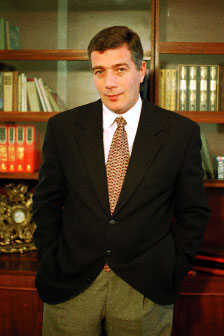
Openhearted, smiling, energetic... Gia Jokhtaberidze is the young manager of a big business. The Magti Group was one of the first to step into the Georgian business world. Slowly and imperceptibly the Magti Group has become part of our lives. At first sight the Magti Group is a symbol of prosperity but in reality it is the result of huge efforts and selfless work. How this work began and has developed up to the present day will be discussed with Gia Jokhtaberidze, who has agreed to speak about this subject since it is a part of his life. Gia is a businessman. In fact this story began not so long ago. A young Georgian postgraduate student arrived in Moscow to study at the Institute of Physics for Engineering. He was amazed at the level and scale of education there. He was starting a new life.
"At the Georgian Polytechnical Institute my speciality was automated systems of management. At the Moscow Instiute I was a postgraduate student in the Cybernetics Department. I am not sure about today, but at that time the Moscow Institute was of a very high standard and was one of the four top quality higher educational institutions whose diplomas were accepted by foreign institutions without further certification. In Moscow I had to work hard to catch up with other postgraduates but after a while not only did I catch up with the rest but I became engaged in serious research. I was not the only one from Georgia, there were other Georgian students at the Institute, who already in their early careers became well-known scholars. As I have mentioned, my postgraduate years were difficult. The number of teachers at the Institute exceeded the number of students, without mentioning the 15 members of the USSR Academy of Science who were lecturers at the Institute. At some of the classes we had one academician per student. The Institute had its own mini nuclear power station, enterprises etc.."
Professor Vyacheslav Gorbatov was Gia’s research supervisor. Those who are familiar with this field know how difficult it was to get enrolled in Gorbatov’s group. The work on the dissertation started. Already, 22 years ago, when cellular systems did not exist either in the Soviet Union or in Georgia, the young Georgian scientist started his work related to such systems.
‘My supervisor proposed that we elaborate a neuron-type model in mathematical logic, which would be based on cellular principles.Such a research paper would be eligible for the following two specialities - first, technical cybernetics and theory of information and second, the automated system of planning. This system was based on the mathematical model of the neutron and on logic. It is a principle that could be implemented in any field - communications, computers and also in the equipment for aircrafts.
The title of the paper was "Automation and Planning of Homogeneous Neurontype Networks". At the end of the 70’s the term “cellular” was already used instead of “neurontype.”
This is how I started and continued later, when cellular systems developed and came into use. It was very pleasant to know that my paper was a small brick laid in the foundation of a big construction. The thoretical assumptions engrained in my dissertation were put into practice.’
Gia Jokhtaberidze is a businessman. He came to business from science. It is hard to tell what type of scientist he would have been today had he opted for scientific work. It is indeed difficult to imagine what scientific work he would have pursued in the Georgia of today.
‘After coming back from Moscow I became a lecturer
at the Polytechnical Institute. The satisfaction that work brings
may be moral - when people know that their work is needed -and financial-
allowing people to lead normal lives. At the end of the 80’s the
moral and financial interests became meaningless and I understood that
I should seek a different way in life and left the Institute. It was perestroika
time and able people were starting their businesses.
In September 1987 I started a business with a
friend of mine and we were soon getting substantial orders from customers.
Our business was to prepare computer software. Although selling computer
hardware was a more profitable job, we were not interested in it. Trade
was never our job. We only created. It is the same in our business today.’
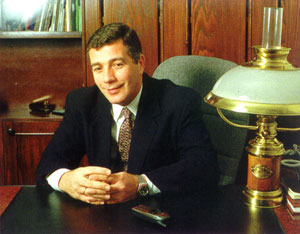
Business and work, above all work. From creating special software and manufacturing original furniture, using equipment purchased from the Russian military, to the most complicated cellular systems.
‘ I have always been thinking about cellular systems. Initially I visited the then Minister of Communications and informed him that there was a possibility of creating cellular systems. He delayed his response, giving thousands of excuses, but I did not give up and started seeking partners all over the world: in America, France, Germany, Austria, Russia, Korea, Israel... Finally I came across the Metromedia Group owned by John Kluge, one of the world’s best-known businessmen. Already in his 30s he had his own radio stations. The President of Metromedia Intenational Telecommunications, Inc. Richard Sherwin, personally came to take part in the construction of a GSM system in Georgia. It was in July 1996. We already had a licence then.
The agreement we had with the Americans was as follows: I was to present them with 49% of the Magticom shares in return for the guaranteed provision of equipment. To be honest they were very surprised that we did not sell them the company but gave it as a present. We were offered money but I refused, respecting the partnership relations. This decision was very much appreciated and we received guarantees. The foundation capital increased and we decided to approach Motorola. In fact we managed to buy a Siemens station fairly cheaply. Initially it was designated for one of the districts in Russia but was not installed there. Then it was offered to an Israeli company, but it failed to develop its business. Finally, we got it, and quite cheaply as well. For the main stations we approached Motorola, concluded agreements, and the equipment started to flow.‘
Science has its rules. So does business. When becoming a businessman one changes one’s lifestyle and builds new relationships. But for every business the main thing remains the same - human values which are universally recognised but difficult to maintain.
‘In fact business will always succeed in two cases: when there is full confidence between partners and when they are not mutually dependent. What can I say about the conditions for developing business in Georgia? In principle the legal basis protects the businessmen; however, a tradition of business development in Georgia does not exist and therefore causes many complications.
The tax system may be burdensome but it is regulated by law. Where taxes are levied under the law they should be paid. The problem is that all should be equal before the law and no leeway should be left. Be it a businessman, an artist or a journalist - they should all enjoy equal conditions. If that is the case everything will be in order. I can openly say that our company is Georgia’s taxpayer No 1.’
Magticom employs 220 people. Their average age is 25, the lowest net salary is 270 laris. The qualifications of the young employees would comply with any international standards and requirements. They are all educated, speak English, use computers, smile and walk around the offices in a businesslike manner. They all enjoy working here.
‘The Magti Group was established by Aliko Anchabadze and myself. We are old friends. As for Magticom, its first director was from New Zealand and was appointed by the Americans. But he failed to keep up with the situation here... The present director, Giorgi Kiknadze, is a doctor. He used to be a Deputy Director of the Medical Diagnostic Center, but he changed his profession and started working with us. For two months he was observing our work. He turned out to be very knowledgeable and gifted for our business and has perfect administrative skills. The whole team is composed of young people. We are a very united and good team whose working relations are based on mutual trust.’
Gia Jokhtaberidze has a wonderful family - an attractive and gentle wife, Manana Shevardnadze. Their relations are based on true love and genuine friendship.
‘The family is very important. Warmth and peace in the family determines a lot in businessmen’s lives. I am truly lucky to have met Manana Shevardnadze. But a family is one thing and business is another. When I started my business, and quite successfully, I was not Eduard Shevardnadze’s son-in law. Naturally the name of Shevardnadze means a lot in our lives.
Being a member of the President’s family helps me a great deal especially in the relations with foreign partners. Needless to say, they trust me more. Shevardnadze’s name is a guarantee for the entire country and it is not surprising that it is a guarantee for me...
In any case half of Georgia is equipped with mobiles today. A large number of these belong to Magti GSM. Everybody uses mobiles: businessmen, politicians, students and shop-assistants. The mobile rules the world more than we Georgians could imagine, let alone foreigners.
To be honest I was quite sceptical at the beginning. However, the most important thing was Metromedia’s support as a partner. Metromedia, as I have mentioned, is a very big company and has companies in various countries. Metromedia gave us a credit and gave a letter of guarantee to Motorola, which supplies us with the main stations. At present we have two credit lines: one with Motorola and the other with Metromedia which is the biggest investor in Georgia today.
In the beginning foreign specialists would come
to help us. Today we have already trained young people who can install
a high quality GSM network in any country.
Despite all the success, problems in our work
remain. People find it difficult to pay and the cases of evasion are quite
frequent. I still think that our business is successful. We develop business
in economically less favourable regions. We would like to be present everywhere
in Georgia and to work for the whole country. We will reach the regions
with small numbers of people and with economic problems. For this
purpose we intend to build 63 stations for 1999.’
This is the profile of Gia Jokhtaberidze, the leader of the Magti Group. The man with whom 25 thousand mobile owners have invisible links. As for Gia, he constantly thinks about the present and future customers of Magti GSM.
What can I say? Let us try to do kind deeds. We
are good and talented, but in my experience what we need to do is to come
close to Europe in one thing: being together. Let us be together and be
well. Our common well-being will mean the well-being of every one of us.