 |
Worldwide processes of integration in the 1970s created new challenges for telecommunication systems. The existing stationary means of communication no longer satisfied the modern day requirements, as there was an increasing demand to provide services to customers on the move. As a solution to the problem, it was decided to connect them to the fixed telecommunications networks through the general use radio systems. Thus a cellular topology was developed. It is based on the division of the territory into a comb-like structure, with a transceiver stationed in each of the cells. The cellular design of the network allows full radio coverage of the given territory, permitting at the same time to use one and the same frequency at base stations located several cells away from each other. That was a major achievement making it possible to provide services to a large number of subscribers with a limited number of frequencies.
The earliest analog transmission systems appeared in late 70s, and have
been in increasingly greater demand since then. In the 80s, analog systems
of cellular communication were developed and introduced in many countries
around the world. The operation of such systems, however, revealed certain
shortcomings. These included incompatibility of different standards, insufficient
quality of communication, dependence on the distance between the subscriber
and the base station, difficulty to encode transmitted messages,
and others. Analysis demonstrated that the only way to address these problems
was to apply digital technology.
The second generation of cellular communication systems appeared in
the 90s. These were digital systems which presented a number of new
solutions, such as a more efficient model of frequency reuse, time division
of channels, effective methods to reduce signal attenuation and distortion,
low-speed speech codecs intended for confidential transmission of messages
via encoding, integration of the telephone service with data transmission,
and a more effective means of modulation.
|
|
The main advantage of the digital technology, however, is the programmed control of multiple processes, including formation of logical channels, use of protocols intended for open communication systems according to international standards, and control by means of an intellectual network.
Currently, several standards of digital cellular systems operate worldwide, including the European (GSM), American (D-AMPS), Japanese (JDC), and others. The European system due to its efficiency and wide possibilities it offers is called Global System for Mobile Communications (GSM).
Creation of the GSM system was the result of the extensive work carried out by the Standardization Group established in 1982 in Europe. The Group developed recommendations for the architectural and technical characteristics of the system. It was on the basis of these recommendations that specific projects were designed by the world’s leading telecommunications companies.
The GSM system provides high quality voice transmission even if the signal level is only 8 times higher than the noise level. By way of comparison, in order to achieve the same result with the D-AMPS system, the corresponding ratio needs to be no less than 40.
The GSM standard offers a number of services which other standards cannot
provide. These services are:
• SIM-cards for channel assigning and service rendering, which permits
the use of the GSM standard mobile phones in any GSM network;
• Wiretap protected interface;
• Message encoding;
• Authentication of subscriber and identification of subscriber’s equipment
by means of cryptographic algorithms;
• Short messaging service (transmitted via signaling channels);
• Automatic roaming (both local and international) for subscribers
of various networks.
The GSM system operates not only in Europe. Global System for Mobile Communication also covers Australia and a number countries in Asia and Africa. Meanwhile, in America the DCS-1800 system which is a modification of the GSM system, is being introduced. This differs from GSM only in its frequency range (1800 MHz instead of 900 MHz).
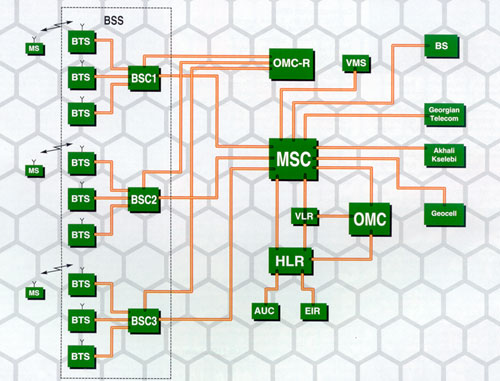
All of the above mentioned advantages prompted MAGTICOM to choose the
GSM standard. The MAGTI GSM cellular communication network is a typical
implementation of the standard (See the drawing). Its main functional nodes
consist of MSC (Mobile Services Switching Center), Base Stations System
(BSS) and Mobile Stations (MS) i.e. mobile phones. The BSS consists of
a set of Base Transceiver Stations (BTS) and Base Station Controllers (BSC).
BSC is an interim controlling equipment between MSC and BTSs. Each BSC
serves a set of base stations located within a particular geographical
area.
The MAGTI GSM network consists of three major areas: Western Georgia,
Eastern Georgia and Tbilisi. BSC carries out call transmission into the
cells of its subject area and exercises control over their configuration
and radio means.
The MSC is connected with the switching center of the Telecom Georgia, Akhali Kselebi and Geocell. It provides communication with subscribers of other local and international networks. It serves every cell within the network and secures all types of connections necessary for the operation of the mobile stations, carries out telephone switching, connection with other networks, signaling via the common channel and other functions. It collects subscriber call data and transfers it to the customer care Billing System center (BS).
The MSC maintains constant connection with the Home Location Register (HLR), the subscriber data base and the Visitor Location Register (VLR), which contains temporary subscriber data. The HLR is connected with AUC and EIR elements, whose functions include identifying, encoding and decoding, securing call confidentiality and preventing fraudulent usage of mobile stations.
The operation and maintenance of the base stations subsystem is carried out by corresponding Operations and Maintenance Center-Radio (OMC-R), while the entire network is operated and maintained by the Operations and Maintenance Center (OMC).
One more type of service included in the structure of the network is the Voice Mail System (VMS), an excellent additional feature offered. In the event of no answer, the calling party may leave a message which can be checked by the receiving party upon reconnection with the network.
While registering a new subscriber, an operator company creates subscriber data in the HLR which consists of an SIM-card number, International Mobile Subscriber Identity number (IMSI), Mobile Subscriber Integrated Services Digital Network (MSISDN) mobile phone number, an Individual Subscriber Authentication Key (Ki) and service features.
Subscriber registration in the network starts as soon as the mobile phone is activated: the MSC verifies whether the subscriber is registered in the HLR. If so, it registers the following subscriber data in the VLR on the basis of the data received from the HLR: IMSI, MSISDN, HLR address, the subscriber’s location LAC area, the phone activation status and types of services rendered to the subscriber. The location area includes a set of cells, where the call is simultaneously transmitted. This may be one or more in the service area of each BSC. After the registration, the subscriber is able to make calls to the customers of its own and other networks as well as to roamers.
When mobile subscriber A makes a call to mobile subscriber B, the call is transmitted to the MSC via signaling channels, which checks subscriber A’s data in the HLR, identifies the VLR of subscriber B, reads its LAC and transfers the call according to the IMSI of subscriber B. After the call is received and confirmed by pressing an appropriate key on the mobile phone of subscriber B, the voice channels are assigned to those subscribers.
When subscriber A calls subscriber B in another network, the MSC verifies its data as in the previous case and, according to the phone number of subscriber B, transfers the call into the corresponding direction: Akhali Kselebi, Geocell or Telecom Georgia, the long distance or international gateway. In order to reach fixed and other mobile networks, the full format of subscriber B must be dialed, i.e. long distance index (8 or 8-10), city or network code plus the subscriber number, and the country code in the event of an international call.
Roaming is a specific type of service offered to mobile subscribers. It is provided on the basis of cooperation agreements between mobile network operators, stipulating the creation of a roaming partner data base in the system of each of those operators. This allows its switch to identify which operator’s subscriber it is dealing with. In addition, roaming partners must have the ability to arrange an S7 signaling channel. With that end in view, the centers of channel arrangement are set up in some European countries. MAGTI GSM is connected with Deutsche Telecom in Frankfurt.
When a subscriber visits another network, he undergoes automatic registration, which considers the transfer of all visitor data to a visiting switch via signaling channel by means of information exchange. As a result, he becomes a temporary subscriber of the visiting switch.
If a roaming subscriber receives a call from his own network, this call will be automatically transferred into the visitor’s own switch via the signaling channel, which will in turn provide the calling switch with a temporary number for a visitor, and the calling switch will use that number to automatically call the subscriber via the fixed international telephone network.
This is how MAGTI GSM operates, the company which brings its subscribers
into the world of constant connection.
| GSM - Global System for Mobile Communications
D-AMPS - Digital Advanced Mobile Phone System JDC - Japanese Digital Cellular SIM - Subscriber Identity Module DCS - 1800 - Digital Cellular System MSC - Mobile Services Switching Center BSS - Base Station System MS - Mobile Station BTS - Base Transceiver Station BSC - Base Station Controller HLR - Home Location Register VLR - Visitor Location Register BS - Billing System AUC - Authentication Centre VMS - Voice Mail System EIR - Equipment Identity Register OMC-R - Operations and Maintenance Centre-Radio OMC - Operations and Maintenance Centre IMSI - International Mobile Subscriber Identity MSISDN - Mobile Station International SD Number KI - Individual Subscriber Authentication Key LAC - Location Area Code |