Often, it seems, it is not that hard to gain fame. Look just how many famous people there are ... Only one thing, perhaps, is really hard to attain - and that is true and profound love.
We believe you are familiar with this feature from our previous issue. Drawing on the opinion of the MAGTI GSM customers, we have attempted to find out who the most popular actor, writer, artist, or businessman is…
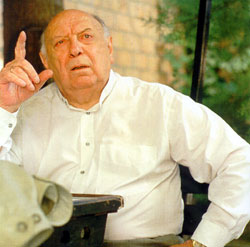
This time the Magtians have named KOTE MAKHARADZE among their favourate Georgian celebrities
Often, it seems, it is not that hard to gain fame. Look just how
many famous people there are ... Only one thing, perhaps, is really hard
to attain - and that is true and profound love.
It is one thing to have titles and acclamation, to be popular, listened to, watched and adulated, but it is quite another when, being alone, someone remembers you, thinks about you and their heart is filled with some inexplicable warmth and tenderness.
Kote Makharadze inspires just such feelings.
Kote Makharadze: “I’d better tell you the truth: it was my mother who decided it all. I was fifteen when I finished a ballet studio. I cannot in all fairness claim that at that time I knew that dancing or acting was the only thing I wanted to do in life. How could a boy of six or seven know such a thing, anyway. Mother sent my sister and me to the Tbilisi Choreographic Studio which I finished in seven years with honours.
“In 1936, the Zarya Vostoka newspaper published a photo of me with the caption: Ten-year-old Kote Makharadze in the Nutcracker. Evgeni Mikeladze conducted the production and the costumes and scenery were designed by Soliko Virsaladze. This was perhaps the happiest episode in all my life. Only one other time, when Veriko Anjaparidze produced her remake of Uriel Acosta did I experience a joy equaling The Nutcracker. The play was directed by Kote Marjanishvili and the unique set design was by Petre Otskheli. By the time of Uriel Akosta I was already a People’s Artist, while in the Nutcracker only a small boy. As I said, my mother played a decisive role in all of that. As for me, I did not even want to dance. In those days ballet was not thought of as a particularly masculine occupation. “Kote Makharadze attends ballet school, what can a real man have to do with ballet”. So, frankly I was reluctant. If not for my mother, I would have entered a different institute altogether.
“Today, things are so different. My grandson often tells me: “Aren’t you ashamed? How can one person excel at everything.” During the war, the People’s University of Marxism-Leninism was opened. Everything there was so formalistic - but here too I did well in all my subjects. At the Theatrical Institute my fellow students always made me to be the last one to take an exam. “If you go first”, they would say, “they will set you as the standard for the rest of us.” I was equally good in mathematics. My father’s dream was for me to become a lawyer, I have always had good communication skills - in any case, I somehow regard my career as something that happened without my conscious will.
“Mother was the chief librarian at the oldest library of School #1.
Even the main public library borrowed from her collection. Father died
young, he was not even sixty. When his “old men” came to us, they would
often lament about “Nodar and Kote pursuing the wrong path.” Nodar
- Nodar Janberidze - is now an academician, and Kote, of course, is me.
Our fathers, two closest friends were absolutely certain that we would
fail to achieve anything...
“I have received many awards, you know, but the most precious one for me is that of Honorary Citizen of Tbilisi. I was the first actor to be granted this honour, and that evening I wanted to go to my father’s grave and tell him that I had not failed in life. He was used to my success - Kote is first in this, and in that, he would say. But when I became an actor, he thought nothing worthy would become of me - and who knows, maybe he was right about it, too.
“In short, I graduated from the ballet studio and I faced the issue of just what do with myself. I was only fifteen then and I was rather short too. What should I do before leaving school? I was still a child and had not yet planned my career. It was then that I began to play basketball, and my long basketball era began. I became the captain of the Georgian youth team, I played in the Tbilisi Dynamo club, but I was hardly number one there...
True, maybe he was not the first, but here too Kote Makharadze was certainly excellent. The years would pass and his childhood passions and perfectionism would determine his second most important occupation which would win him enormous popularity and admiration. But all that was still to come, in those days, however,...
“It was then that I saw Akaki Khorava in Othello and all my plans went to the dogs. I became obsessed. I did not want anything else. The Rustaveli Theater and Akaki Khorava was the only thing on my mind. Today many think too much of themselves, some think they are greater than Khorava. Let them! However, many boys and men in those days enrolled in the Theatrical Institute because they wanted to become Khorava. .. He was everybody’s idol. It was my aunt who took me to the performance. After seeing the play, I lost my sleep for two or three nights, literally. Mother told me I was delirious at night and scolded my aunt for taking me to the theater. By that time I had already seen Chabukiani live on the stage, although I was still very young when that happened. He appeared on the stage and literally suspended in mid air, as it were. I only perceived it as a physical trick. I had not yet developed an aesthetic perception. Later, when Vakhtang returned to Tbilisi, he came to the theatrical Institute together with his company. I was selected to meet him along with some others. I, however, climbed over the iron staircase and escaped - you see, I knew that I would not be able to say no to Chabukiani, so I chose to sneak out. Perhaps I saved my life thus, or I would have been a retired man for thirty years now. Nobody thought he would stay in Georgia - not the Chabukiani who conquered America in 1934... It is easy now -after all, everyone who can move their butt goes there.
“At the Theatrical Institute, I became Dodo Aleksidze’s student. Khorava was then Director of the Theatrical Institute. I had no protector, someone who would pull strings for me and help me in my career. I often tease Sophiko with, ‘Unlike you I did not arrive on the stage with the rank of captain.’ To this day I believe that it was Dodo Aleksidze who played a decisive role in my professional growth and formation. It is sad that today he does not receive the due recognition and credit he deserves.
“As fate had it...” “Perhaps it was destiny...” “It is all due to him...” “If anyone deserves credit...” All these phrases abound in Kote Makharadze’s vocabulary.
Moderation and modesty, the feelings of dignity and gratitude are part of his character. Perhaps, these are the very qualities that make Kote Makharadze’s so charming and attractive.
He believes himself to be lucky, as he has worked with so many brilliant directors and outstanding partners. He believes that his many roles - so diverse encompassing both comedy and drama, irony and lyricism, have come to life due to such fortunate collaborations.
These characters we have come to love and admire.
Soon, and very unexpectedly, a new role appears in Kote Makharadze’s life.
“I already held the Honorary Artist title. I had played many parts and
had won recognition when something quite unexpected happened in my life.
An American basketball team arrived in Tbilisi. Erosi Manjgaladze would
only comment on football matches - Not because he was unable to do other
types. He could have done anything, but that is how it was anyway. When
he was asked to provide a basketball match commentary, he answered,
‘Call Kote instead, he is a Master of Sports in basketball.’ Actually,
I was not, but that’s what he said. I hesitated, I could not even imagine
myself in this role. You know why? When Yuri Gagarin first went to the
space and we thought that no one else could top him, well, Erosi was just
like this to us. Never, even in my thoughts had I imagined I would some
day do such a thing. We were friends, and never, even jokingly had we discussed
this or entertained my doing it. Basketball is a game three times faster
than football. Besides, there were no television broadcasts, and in the
radio to a listener who sees nothing you must explain everything. I plucked
up all my courage, made up my mind and did the sportscast.
That is how it all began. Two days later I was commenting on a football
game between Leningrad’s Zenith and Dynamo Tbilisi. Later, the television
and radio management could not even imagine broadcasts of major championships
without me, even though one of the Russian ministers once told me, ‘You
have an oriental accent.’ But people apparently got used to it. I
am not very proud to admit this as an actor, but the exposure from that
sportscasting brought me a lot more popularity. I sometimes think that
none of my parts in the cinema or theatre have brought as much joy to the
people as my commenting did during just one game in 1981. The credit should
go not to me but to the profession. Why should I be ashamed of this profession,
and claim that I am only an artist. Which I am, but... Perhaps I have something
which sportscasting requires. Erosi, for example was not a football expert,
but when he commented, the entire country screamed and shouted listening
to him. This cannot be taught. If you have a talent, you have it and that
is it. There is an intonation there, a force which you use to touch everyone.
“Sports Commentary has brought me enormous popularity and joy. But
I still think I could have succeeded in other professions as well. It may
be that I would not have become so popular, but I still could have done
more. I do not mean poetry though, although I did write some, too.
Perhaps not everyone knows that Kote Makharadze’s Russian translations of Galaktion Tabidze have been published several times. And his Georgian translations of Mayakovski have been included in many Mayakovski’s collections in the Georgian Language. It is very well known, however, that Kote Makharadze has written stage scripts for Leo Kiacheli’s Tariel Golua, Mikheil Javakhishvilii’s Kvachi Kvachantiradze, and many others. He has written an original play Two Records which was mounted in the Theater of Musical Comedy. He is also the author of the book Seen and Experienced. Many will also recall other articles of his as well.
Had Kote Makharadze not been an actor, perhaps he would be known as a man of letters, and a good one too.
“I am not pretentious. When Akaki Bakradze and I once began to write about Ilia Chavchavadze, they said, “What can he know about Ilia?’ But people at least learned that he was killed by the Social Democrats. When the statue of Philipe Makharadze was blown up and the search began for the culprit, Otar Litanishvili said, ‘You do not need to search, you should arrest Kote Makharadze.’ I often think that had I given more time to writing articles and essays, I could have mastered it. Now writing does not come easy to me and do you know why? What you might be able to write in three minutes, would take me a long time. Mastery requires hard and daily work.
“To be frank, I still regret... I have the feeling I have not been able to fully say everything I have wanted to. I have not done all I was capable of doing. I simply chose a different career, while maybe writing could have been my main vocation. I just think so, I may be wrong. I do not think that I have ever been complacent or unrealistic about my real capabilities. You know, I am the first laureate of the Akhmeteli Award. This award is only given to directors, not actors. Robert Sturua has also received this award. There are so many great directors, I cannot be compared with them. It is funny, but what can you do... Then I directed a performance in the Marjanishvili Theater and I was the first to say what a disaster it was.”
Ten years ago, a one-actor studio appeared in Tbilisi Kote Makharadze’s Theater. This theater is named after Veriko Anjaparidze and is housed in the house-museum of Veriko Anjaparidze and Mikheil Chiaureli. Since it was founded, the theater has played to full houses. Many performances have been staged: What Was Destroyed by Animosity, Bagrationi, Wake up my Harp... among others. With immense force and feeling, stories of Georgia, spirituality, morality - all have been pouring from the stage. This small yet extraordinary theater has become a harbor of rediscovery of moral values, thought and feeling in our difficult and chaotic reality.
“Now we are working on a new production about those Georgians who were
not fated to be buried in the Georgian soil. Queen Tamar, Shota Rustaveli,
King Vakhtang VI, and those boys who fell victim of the war in Abkazia
and many others.
“Well, that is what I am doing now. Starting from the Rustaveli Theater,
I have worked on many different stages. It will soon be 29 years that I
have worked in the Marjanishvili Theater. But I have not been there for
the last four years. The only question that I will not answer you now is
‘Why not?’
“I am a professor of the Theatrical Institute. There are many challenges,
much needs to be done. Especially Georgian diction and language. My heart
sinks when I watch television or listen to the radio. And when a child
watches it, or even listens to the parliamentary sessions, why, he thinks
that is the Georgian language.
“ Generally, look at what is happening. Not everything can be
sold. Do your job well and it will bring you the money. But it requires
hard work. I do not want to die without seeing actor’s life remain so insecure
as it now is. I will fight till my last day. Until now I have been silent,
but now we must do something, this cannot continue any more.
Still he prefers to talk about positive things.
“Even if only for the fact that I got to meet Pele, Maradona and Kruif personally, it was worth it. My happiest day was when in the night of 1981 when I got to declare for the whole world to hear ‘Goooooooooooooal!’
And Kote Makharadze is happy in his personal life.
“I love being with my children and grandchildren. Today I dropped in to see Maka at the college. Iviko was there too. Earlier today my younger daughter came with her little kid. He refused to go home, he is two years old. Alexandre screamed that he wanted to stay with Kote.
“Sophiko is my third wife. I do not know why they say about me that I am a destroyer of families. I would lie if I say I have never looked in the direction of a woman, but I have never even stolen a glance at a woman at table or anywhere else if she was there with a man. It does not matter whether he is a husband, brother, lover, friend, stranger, or someone else. She is with a man and that means it is a forbidden zone for me. I have always been decent that way.
“You know what has been a real blow to me? When Christian Bernard, the man who conducted the first heart transplant, said when he was in Moscow: ‘There is too much fantasy surrounding the heart. It is an ordinary organ, a muscle and its sole function is that of an physiological organ.’ I was simply astounded by this revelation - so all world literature proves to be in vain. It was a real shock. Galaktion’s poetry... that the heart had nothing to do with it?
“My heart or muscle, I do not know what to call it now - it often aches. It aches for example because Sophiko and I have no children. Have we done anything wrong? Maybe. But the God is my witness I wanted a child so very much.
“When I was given a shot of anesthesia before an operation in England I thought I might never wake up again, but I was not afraid. My only concern was that Sophiko would be alone. I knew very well she would not, she has children and grandchildren, friends and relatives, many admirers, but without me she would be alone anyway.
Indeed Kote Makharadze seems to have everything - titles, love, recognition, and he is one of those rare individuals who feels himself to be blessed. Perhaps it is this feeling that gives him strength and energy to continue to do everything with honesty and habitual excellence.
MARINA VASHAKMADZE