Once, during a break in negotiations in Moscow, George Schultz unexpectedly asked Shevardnadze, “Do you miss Georgia?” Then, just as unexpectedly, he sang the phrase “Georgia, Georgia, on my mind...”
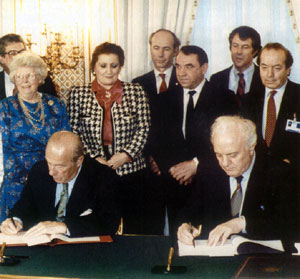
On the day of the first major victory on the subject of nuclear disarmament - the signing of the US-Soviet treaty, on the elimination of short and medium nuclear missiles in Washington - in the huge Franklin Hall at the US State Department we had a surprise. The Kakhetian song, Mravaljamier, was sung with gusto. It took my breath away. I felt someone’s gaze - and I will never forget it. Shevardnadze was looking at me from the distinguished guests table. As the Yale Choir was performing one of the greatest anthems of our land. We held each others eyes and silently communicated our feelings of that moment - it was our subtle acknowledgement to one another of the place Georgia held in our hearts.
Teimuraz
Stepanov-Mamaladze
| “I have said many times that I returned to Georgia, with all of my
past experience, contributions, and mistakes, with all my burden and political
capital, all that I have, that I will create and write will belong to Georgia.
I returned, never to depart my country again. To use all my remaining strength,
knowledge, experience, name, and acclaim - if such exists in the world
- to benefit Georgia.”
Eduard Shevardnadze The Future Belongs to Freedom, 1992 |
That Smile Destroyed the Berlin Wall
It was in 1967 that the Hotel Iveria opened in Tbilisi with great fanfare.
My husband, Lado Meskhishvili, and I were invited to the government banquet.
This was the first time in our life to be invited to such an event, and
we were delighted.
At an enormous table sat representatives of the so-called nomenclatura, dressed in dark suits as uniforms, with similar bland ties, and carefully weighed expressions on their faces. Their “dignified” smiles were filled with self-satisfaction. I was sincerely interested in this cast of characters. I had just returned from filming on location and compared to that bohemian life, everything here seemed alien.
Opposite us was seated a young man, not at all like the others. He was fair headed, with light blue-grey eyes which revealed intelligence and vitality. His toothy smile especially impressed me. Only American performers and Presidents smiled in such an uninhibited fashion. At first the party was dull and monotonous - the Communist Party stamp was all over it. First the toast to the Communist Party, then to the First Secretary of the Central Committee, Mzhavanadze. In order to keep from falling asleep, my husband and I began to play a game. We tried to identify who the mysterious blond man was. We were sure that he was not a man of high position, and we went through the creative arts professions, but to no avail.
My neighbour, a black-suited functionary overheard us and barked in a fearful, hushed tone “It’s Eduard Shevardnadze!” I was astounded - so this was the Minister of Internal Affairs whose name struck fear into the hearts of all. Someone in the same whisper corroborated this - indeed it was Shevardnadze. I was overcome with glee - “Are you the Shevardnadze? The Shevardnadze?” I roared out with laughter. It was Shevardnadze himself who defused the situation, laughing heartily himself. Afterwards, others joined in the laughter. It was infectious.
Since that day, regardless of his position or the trials he has endured, I have thought of him as a normal human being. One of us. His smile, or laugh, have such a human quality, and more than anything else, laughter is really capable of overcoming animosity. This was echoed around the world - that the Berlin Wall was destroyed by that smile.
Lana Ghoghoberidze
| “I like when someone does his job with a smile and knows the value
of a humorous word. We are all human, after all, and trying to find the
ways into each other’s minds and hearts.”
Eduard Shevardnadze
|
An Ethical Aura
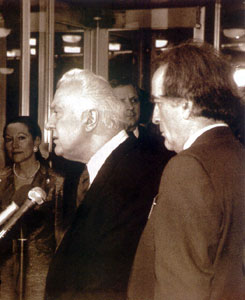
Radio Interview with Gela Charkviani,
Head of the International Relations Service of
the President’s Chancellery
By Lia Dzidziguri
Sir, you are a member of the President’s team - how did you happen to become a part of it?
I had met with the President on several occasions before his return to Georgia in March of 1992. I remember that call on April 26, 1992: “If you could come tomorrow to Mr. Shevardnadze...” I was able to guess what it would be about - they wouldn’t be summoning me for no reason. So I went. The meeting took place in the IMEL Building, and Mr. Shevardnadze asked me “Would you like to work on this team, and head the International Relations Department on my staff?” Without thinking twice, I accepted the invitation. Some might say “Well, of course you agreed - who would have refused such an offer?” You must understand, however, that this was hardly a prestigious “post.” In fact, a real state did not exist then, much less a real staff. It was in every way a risk. I will explain why. There, in the IMEL building, who do you think was around? The halls were teeming with characters who had been drinking and smoking who knows what. Also, they were bristling with guns. The “ambience” was something beyond the imagination.
May I offer the word “chaos?”
Chaos - yes, indeed. So you can see why this was hardly what could be described as a post. True, a salary was fixed, but in reality there was just work and nothing much else.
I understand that there was nothing enviable - save perhaps one thing.
Save one thing - that was the chance to be a participant in building a new Georgia. This was an enormous privilege. My acceptance of the offer was determined by this opportunity. We had in fact lost even the last vestiges of our statehood by that time. I had no doubts that Shevardnadze was the only person who would set the country on the road to democratic nation-building.
Why did you have no doubts?
You know, I’ve read so many references to Shevardnadze in the memoirs of other people. In my opinion, however, no one has succeeded in writing about him with any precision or accurately describing him.
This is perhaps a thing of the future...
| “I do not agree with those people who think that
if a man is a politician he must have iron nerves and an iron heart. Nothing
will come out of such a politician - he must have a human heart.”
Eduard Shevardnadze Iberia-Spektri N39, 1992 |
Perhaps, but one thing was obvious to me then. Do you remember how Shevardnadze came to the political forefront to begin with? With Shevardnadze came an aura - an ethical aura. I remember it well, although I was much younger then. The body of Shevardnadze’s work during his entire life was based on moral principles: remember, during his first period of leadership in Georgia, there was no ideological pressure. This was extremely important for me personally. He removed ideological barriers in the arts, in culture, and philosophy. It is for this reason that I did not have any second thoughts about whether Shevardnadze would build a democratic state. He would. Remember the eighties. Who were his friends during that period? Baker, Schultz, Genscher. They served a democratic ideology. How could Shevardnadze have gone from there to building a banana republic-style dictatorship here? It would have been impossible although people, in fact, did sometimes demand this. They would say things like, “why doesn’t he use his fist?”
But we do remember him so, as well.
That is exactly it! In the earlier days he fought corruption, as well. It was impossible to carry out significant economic reform in a small corner of such a vast country as the Soviet Union. But do you remember his economic experiments in Poti, in Abasha? What was he doing? He was introducing market incentives! Here I want to focus on one of his particular qualities. Shevardnadze is a purposeful man. Removing ideological pressures, making experiments - all of these things were a part of a coherent policy. Of what relevance were they to our present day? Enormous relevance. Who are those people - like myself, for example - that have this pro-Western mentality? This mentality is the result of the liberalisation which he pursued in Georgia as First Secretary of the Central Committee. This is my response to the question of why I had absolute faith that Shevardnadze would build a democratic state. He could have pursued no different course, despite the demands of some that he adopt a tougher manner. Perhaps he could have. Also, everything then was like dough. You could have moulded Georgia into anything - an entirely different form of state which, I might add, has been done in more than one of the former Soviet republics.
This would have been an easy course, perhaps...
Considerably so. In a sense, he could have secured his election not
through the electoral process, but through fear.
Shevardnadze was the leader of Georgia when he served as the First
Secretary of the Central Committee, and now as President. Do you imagine
him in a non-leadership role?
No, because there are few precedents in the world - maybe none - where a person has led a country for so long under a totalitarian system, and then has his leadership acclaimed two subsequent times by popular, democratic vote.
And a third time too?
I hope for the third time, of course.
Very well. We often witness, and see on television as well, when the President established informal, frank, and sincere relations with the leaders of other countries. What is it about him that is so magnetic?
There are many things. First, he is a political “Patriarch” by virtue of his experience, age, and renown. He has an uncanny ability to accurately predict the direction events will take. He is a man without fear. He does not wait in fear of terrorist attacks, for example. Obviously, such attacks would be horrible for anyone to endure. After one such event, he told me that “the horrible sound of an explosion still rings in my ears.” That is a natural feeling- he is human after all. But he is a courageous man.
I do not know if I accurately understand the idea I read in Shevardnadze’s book when he regards it a personal weakness that he, as a politician, tends to think a long time before taking a decision, and that he does not arrive quickly at a conclusion...
He does not move quickly because he wants to make the best decision. Besides, it depends. There are times when he takes an immediate decision - according to how many variables are involved in the decision. It is like an equation, which requires time to think in order to solve. On the other hand, he has a swift intellect and he instantly grasps the implications of what he is hearing. Furthermore, and equally important, he is often one step ahead of you when he is listening.
Tell us about his universally known sense of humour - his unexpected and swift ability to defuse tension in a single stroke... As one of his close associates, can you give us an idea of him - is he tolerant, kind, attentive? In general, is it reasonable to expect these qualities as well, from a statesman?
As I see it, he is soft in situation where he can be soft. But he can be hard, and is capable of making decisions which can hardly be described as soft. He is very attentive. He individualises his relationships with people, and this is the very definition of attentiveness. If he fails to exude sufficient warmth on one day, he usually compensates for it later. This means that he is not indifferent. He is as strict and demanding of himself a he is of others. When a person works a 17 or 18 hour day, can he be anything less than demanding of those around him? Generally, his diligence is the stuff legends are made of. When you see the demands the president places on himself, you cannot spare your own energies.
We often are in situations when we do not sleep the entire night for more than one night! I remember a time during the war in Abkhazia... Shevardnadze was there in Sukhumi. Now, just imagine - economic collapse, no real statehood. The intense interest of foreign journalists, someone new always arriving, as always happens when something dramatic and scandalous is happening. Then Sukhumi fell. On the previous evening, I had called Shevardnadze because a famous American journalist was unable to risk travelling to meet him in Sukhumi, and we were placing the call from the then Chief of Staff Vazha Lordkipanidze’s office. This was the only time I heard his voice sounding completely devoid of hope. “What is it, Gela,” he asked. I answered, “A man is here. I realise now isn’t a good time to be asking you, but...” “Tell me what he wants...” was the answer. Can you believe that he answered all of the journalist’s questions. His voice had a desperate quality. If you remember, it was then that he made that address which resonated around the world.
It did resonate - but nothing more happened...
True, but once an idea resonates, it is never truly lost. All that I have said today gives a sketch, and image of the man. In football you may say a player can strike well, or run fast, or has great field vision. Pele had it all, and this is why he was a star. Shevardnadze is like this, too. He has many qualities which are rarely found together. His power and success come from this. Many politicians have some of these qualities. But such a concentration, I repeat, is rare, indeed. If anyone else has had a similar constellation of qualities, be sure that they were individuals who made history as great statesmen and leaders.
(This is an abridged version of the interview.)
Personal Metamorphosis
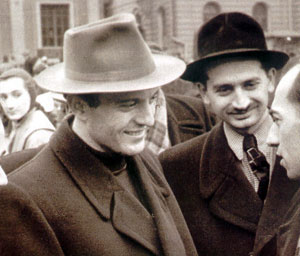
On September 29, 1972, Eduard Shevardnadze was appointed First Secretary of the Central Committee of the Communist Party of Georgia. On that day, he visited his new office first, and then went from there to the Mardjanishvili Theatre. This was no accident. It was a significant political gesture.
Recently, talking with Shevardnadze’s current opponents, I said, “Whatever we think or do, we must believe God’s hand is in it.”
Shevardnadze’s personal transformation, metamorphosis, his entire biography - first the family (I attach great importance to the fact that he came from the family of a teacher, in which his attitude toward his native language was formed), the various positions he held which shaped the leadership style of this talented man - all these prepared him to lead us where we are today. I believe that this preparation was by God’s will - and so was the fact that he was Soviet Foreign Minister, and not the Minister of the Interior, or head of an economic ministry for example, since no other post save this one would have given Shevardnadze the contacts which so enormously benefited this country.
I think that his personal metamorphosis was a gift which he received through his affinity for culture and the arts. He is quite a writer himself. In fact, his attitude toward the arts has never been one of a mere spectator.
Eldar Shengelaia
Remember My Words
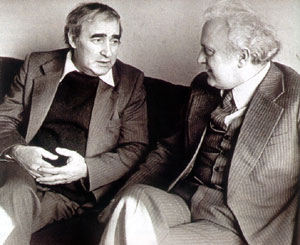
It was in 1984, if I remember correctly. At spring’s end, Father was already feeling very bad, although he did not let it slow him down. He continued going to the Writers Union every day, coming home late at night.
One evening when he was too late, Mother asked me to call the Union. “Don’t fret, Ketino - he is well and now he’s at the Central Committee meeting with Shevardnadze. That’s why he’s late,” the secretary, Maiko, reassured me.
That evening, when Father came home we were dying of curiosity but were reluctant to inquire about his meeting, sooner or later he always told us whatever he could anyway. He finished his dinner silently, but finally, he gave in. He gazed into the distance, dreamy and sad-eyed and said to us, regretfully, “I cannot tell you what Eduard and I talked about. What he plans to do is beyond the imagination, impossible today, and I will not live to see it come to fruition. But if everything goes the way he foresees it, remember my words - Georgia and his name will resonate in the cosmos.”
Father died that fall, and six short months later, Shevardnadze became Soviet Minister of Foreign Affairs.
Keti Dumbadze
The Moment of Truth
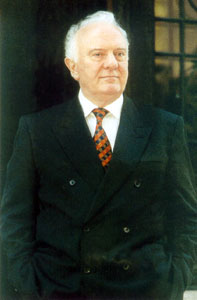
A political and biographical portrait of Eduard Shevardnadze could already bear several sure strokes. First, it is clear that Shevardnadze is a towering figure in Georgia’s history. Events of great significance not only to Georgia or Russia, but of global importance - the disintegration of the Soviet Union, emergence of the New Independent States, the regrouping of powers in the world and others - all are associated with his name. It is also indisputable that Shevardnadze is an extraordinary man. No matter what is the finale to his life and work, it can be said without exaggeration that Georgia has not produced a more prominent person in the twentieth century. With the exception of Stalin, perhaps who certainly was not a Georgian politician, but a Russian politician of Georgian origin, no one has influenced the events in our country to the extent Shevardnadze did.
We can also speak of certain personal traits. Shevardnadze has always
been extremely cautious and unhurried. He does not have rigid doctrinal
views. In other words, he is not a man ‘hooked on’ one idea. Shevardnadze
is a pragmatic man, he never goes against the current, he does not try
to bring about a reality contrary to prevalent trend. Rather, he tries
to obtain maximum benefit from the existing realities. Shevardnadze has
a singular political intuition, as he has often demonstrated.
Shevardnadze is often criticized for manipulating the balances. But
this criticism is unjustified - not because he is not indeed doing this,
but because it is his only natural recourse. Any head of state must
balance political forces as an indispensable element of the technology
of power, which was and is being used by all sagatious leaders. Of course,
the correctness of applying such tactics in specific cases can be argued,
but to reject the principle itself, thereby reducing it to mere political
expediency is not the correct approach. There is no leader who does not
try to consolidate his power - and in so doing, attempt to balance the
influential forces.
Today, Shevardnadze is the President of an independent Georgia. At this point in time, it is important to comment on his Communist past. Had he been sincerely devoted to the Communist or Russian imperial ideals, he would have been somewhere at Gennady Zuganov’s side or would have been reduced to a political ghost, like Gorbachev. Today Shevardnadze’s main objective is Georgia’s integration into the Euro-Atlantic space, since this is a guarantee of the Georgia’s independent statehood and the well-being of its people. Shevardnadze’s political future hinges on the success of this strategy. He cannot retreat now. Five or six years ago, he might still have been an acceptable figure to some forces in Russia, if he had rejected his pro-Western orientation. But today Shevardnadze has crossed the Rubicon. The die has been cast.
It is often said that Shevardnadze is a good tactician, but lacks strategic vision. Such arguments were once abundant in the Georgian press. In reality, it is quite the opposite - Shevardnadze has a clear and cohesive strategy. It was on Shevardnadze’s initiative that the Eurasian transport corridor became a priority for Georgia. He made great efforts to make the trans-Caucasus oil pipeline and the TRACECA project a reality. A Western orientation and the integration into European structures is clearly the strategic line consistently pursued under Shevardnadze’s leadership. These can not be denied, and one must be a rabid anti-Shevist to ascribe them to underhanded intentions.
As for Shevardnadze’s ultimate portrait, it will entirely depend on how successfully his strategy is carried out. The 2000 elections in which Shevardnadze has no viable opponent will be tantamount to a moment of truth for him. The portrait of Georgia’s most prominent person of the twentieth century will be completed in the early twenty-first century after Shevardnadze is re-elected President of Georgia.
David Zurabishvili
Moral Politics
All nations, large or small, have their unique identity and mission. When a nation is carrying out its historic obligation, then even if it is small, its service to mankind, its contribution to the culture and life of the humanity, is great.
The restoration of a lost national mission, establishing a place for Georgia in the global context, and uniting the nation around this common goal were the only prerequisites for the salvation of our country at the beginning of the nineties.
When the one who has participated in the great shifts in world politics, who - as was recognized by many great Western policy makers - introduced morality into politics and brought a humane element into the forefront, whose ability to build personal relationships is specially noted, returned to this derelict country, we placed all our mistakes on his shoulders. Instead of standing by him, we even accused him of “selling” Abkhazia, of being a “CIS-ist” and what not.
We did not appreciate much of his previous work either. In 1973, when the Secretary of the Central Committee of the Communist Party of Georgia called the 20th Century the ‘century of the fall of empires’, we of course only thought of the former dominions of England and France. Who would have imagined the collapse of the Soviet Empire - or considered his concern for the GDP per capita and the energy sector to be a part of a long-term plan for Georgia. While the man who would eventually become one of the authors of the Soviet transformation and one of those who helped dismantle that empire was still In Georgia presenting himself as loyal to that Empire, experiments were being conducted here that were in fact the precursors of today’s market reforms. We also failed to appreciate that thanks to Shevardnadze, instead of celebrating Georgia’s unification with Russia, we celebrated the 200th Jubilee of the Georgievsk Treaty. Nor did we see that in no other Union republics did national culture enjoy such a flourishing environment as it did in Georgia of those years. Or see his role in the public movement to preserve the status of our state language. We nearly crucified him for the ‘sun which rose from the north’ instead of considering how his words alleviated pressure and delivered us from who knows what evil imperial plan?
We did not give him enough of our support.
Not only do prominent statesmen credit him with the introduction of morality into politics - they give him moral support as well. Which former Communist has won such international acclaim? Who is recieved as he is? Who else has inspired the emergence of so many supportive groups? Let’s recall the many references to him in official correspondence as ‘brother’ and ‘friend.’ In this respect, Shevardnadze is unique. Such generous expressions of personal trust on this level are not often to be seen.
We need to consider also how unusual is for a small country like Georgia to produce political figures of such international standing. God grant us future politicians of such talent, yet gaining international recognition requires an international dimension. How long will it be before this happens? When will events in the world develop so that a Georgian is given an opportunity to make his mark on shifts of planetary scale. The ‘evil empire’, Cold War, Afghanistan, the Berlin Wall - all these have already happened.
The turn of mankind toward moral politics will always be linked to Shevardnadze. Future generation of Georgians will be grateful to him for a free, democratic, and revived Georgia. Everyone for whom the progress of mankind is dear will be beholden to him. He has served his nation through moral politics and steered it toward universal ideals.
Time will not lessen the brightness of his contribution. Morality is eternal and unchanging. It is not measured by transient criteria. Whenever morality is threatened, Shevardnadze’s example will guide politicians. The world knows his value. The enemy also knows his value and this is the reason behind the terrorist attacks on his life. Shevardnadze does not need our accolades. But we need to recognise his phenomenon for our own growth, since by correctly understanding events and seeing how our leader with great wisdom, sacrifice and patience has managed to put Georgia in a universal context, we ourselves will be elevated. If we see his work correctly, we will also understand how we should serve the cause, that is, Georgia’s revival.
Manana Gigineishvili