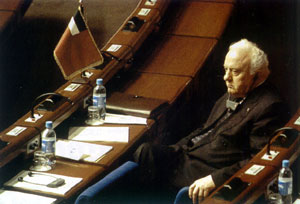
Chingiz Aitmatov
The path you have travelled has been one of history... Our life has spanned two counter-epochs of unprecedented events.
Your personality encompasses the intellect of a statesman, the national ideals of your country, and the universal human values of the 20th Century.
As time passes, you encounter even greater difficulties, but the nimbus of your service to humanity also increases. But will everyone understand, will everyone appreciate your mission? What can one do? Such are people, such is the essence of society, and such is the lot of a leader.
Then, Nobody Expected to See Him as Boss
Vladimir Lomeiko,
Special Adviser to the
Director-General, UNESCO
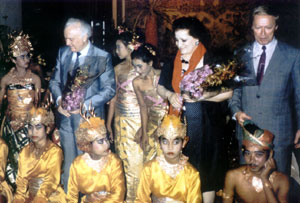
Eduard Shevardnadze’s appearance in the office of Soviet Minister of Foreign Affairs on July 2, 1985 as the boss was unexpected for us, the ‘residents’ of the high-rise building on Smolensk Square, as well as the entire international diplomatic corps. As it later became evident, however, the one who appointed him to the post did not expect him to operate as a real boss. Mikhail Gorbachev, who, as a rule, was confident that he never made mistakes, would never have imagined that he might not be the only, plenipotentiary master of the country’s foreign policy. His idea was to replace Gromyko’s overwhelming, and long established persona with a newcomer in international affairs - the result being that Gorbachev would de facto perform the role of head of the foreign office. Although the authority of the Secretary General of the Communist Party was unbounded, Gorbachev miscalculated: room No 706 of the Ministry was occupied by a real boss - one of the house, and of its affairs.
I remember vividly how entranced we all were by Shevardnadze’s words in his first meeting with the Ministry’s leadership, which instantaneously echoed throughout the building. “I rely on your support, particularly as it will be hard for me to work in the shadow of Andrei Gromyko’s reputation and legacy. What am I compared with this great battleship of world politics? I am only a small boat - but one with an engine.”
Starting from his meetings with his first deputies down to the heads
of the departments and subdivisions, Shevardnadze achieved psychological
victories which would have significant impact on his own work and that
of the entire Ministry - and thereby consolidated his personal and, ultimately,
professional authority.
| “Sometimes when you find yourself at an impasse,
a mysterious force gives you a slight push and guides you out of it. At
such times, I think a divine hand is at work.”
Eduard Shevardnadze
|
Still, what was most amazing to me? What do I remember most vividly after my meetings with Shevardnadze?
It was how he listened to and heeded the opinions of others, and was never too hasty in expressing his own view beforehand. This was true when he dealt both with his own people and foreigners. I have often attended his meetings with heads of state, his counterparts, and other distinguished public figures, and I have come to realise how truly appealing this style was. He was able to create an atmosphere of respect and trust. This was not mere posturing - it was the product of an intense, internal percolation of ideas and feelings, a sincere interest in the interlocutor. And finally, it stemmed from the deeply internalised tradition of Georgian hospitality and the culture of human relations.
At the Dialogue of Cultures: For Solidarity Against Aggression and Intolerance held in July 1995 in Tbilisi, I remember how amazed the participants of the International Forum were when Shevardnadze after completing his remarks at the opening of the Forum did not leave, as other leaders would have done. For the three days of the Forum, together with Federico Mayor, he remained, listened to every speaker and spent time conversing with them. At the closing rally, he stood alongside the others on a hill where everyone could see him, even from afar.
This was not an attempt to show off. It was an expression of respect for his guests. Despite whatever risk was involved, he, as the host, regarded it as his duty to be together with those whom he had invited to his home country.
This is my most vivid recollection of Eduard Shevardnadze. The many calls and messages received later at UNESCO Headquarters after the terrorist attempt on Shevardnadze’s life several weeks after the Forum echoed the same sentiments.
It was no accident that the Spanish and Catalonian Federico Mayor, who knows firsthand what violence is, spoke with such emotion about the atmosphere of solidarity and togetherness at the Tbilisi Forum, about his great admiration and respect for the courage, dignity, and determination of Shevardnadze and his co-thinkers.
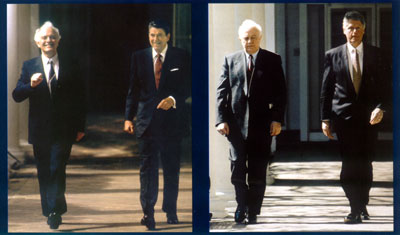
William Jefferson Clinton,
President of the United States of America
Your many friends around the world should take the time to ponder the
contribution which you have made toward establishing peace and stability
on the planet. They should consider how during your leadership of Georgia,
her independence is being strengthened, well-being is increasing, and economic
and democratic reforms are rapidly taking place. These are indeed historic
achievements which will continue to encourage those who look to you for
inspiration.
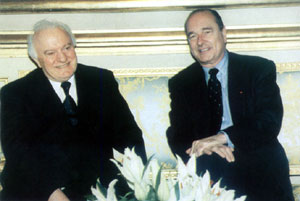
Jacques Chirac,
President of the French Republic
I have known Eduard Shevardnadze for a very long time, and we are in frequent contact. His vision and his humanity have always greatly impressed me. I am not surprised that his leadership opens the door for Georgia, and provides his country with the powerful impetus to enter the third Millennium as upright and strong as possible.
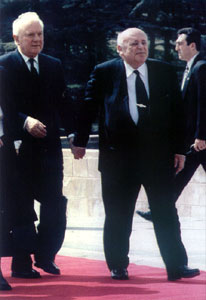
Suleyman Demirel,
President of the Republic of Turkey
There are such decisive moments in history when a particular politician, leader, or statesman is destined to change the course of history.
The history of any event is always the history of an individual. Eduard
Shevardnadze is just such an individual. At that critical moment in history
when the Cold War threatened to heat up, he made his entrance on the international
stage, and with great intelligence and farsightedness he began to change
the course of history.
He was one of the figures central to the closure of that chapter and
the opening of another. His courage and vision not only helped to bring
about independence in his own country, but it inspired millions with hope
for the future. Thanks to his vision and heroic stance, hope has prevailed
over fear.
Owing to Shevardnadze’s wise leadership effort, Georgia established her rightful place in the world community. Today, Georgia is a primary factor of stability and peace in the Caucasus.
Shevardnadze has played a decisive role in building a future where peace, freedom, hope, and prosperity will become an enduring reality. For this, the world will always be indebted to him.
"We, the Germans can thank Eduard Shevardnadze by helping his Georgia"
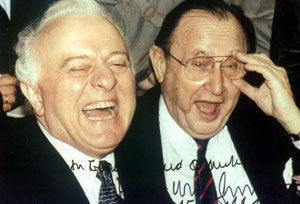
Last October at the Berlin Cathedral, Eduard Shevardze was awarded the
Ludwig Wunsche Prize. According to the chairman of the Kuratorium of the
Wunsche Foundation, Ludwig Wunsche is the symbol of the generation who
after World War II began to rebuild Germany from ruins.
Hans Dietrich Genscher
made the following remarks on this occasion:
Today the Hamburg Ludwig Wunsche Foundation is presenting the Ludwig Wunsche Prize to a distinguished man. Eduard Shevardnadze is one of the architects of the new Europe, the Europe that is based on the values of freedom, democracy and human rights. He is among those who with their vision, courage and determination have helped destroy the Wall that divided Europe and Berlin. Giving this award to Shevardnadze in this very place is a tribute to the man without whom there would be no unified Berlin or Germany, and no undivided Europe. The Foundation is honouring a European statesman, a Georgian patriot, a farsighted man, Eduard Shevardnadze. It honours a fighter for human rights, dignity and freedom. It honours the man who has made possible the rule of law in Georgia, and not the rule of force. He must also be given a god deal of credit for the new culture of coexistence in Europe, based on equality and brotherhood.
We are honouring the man to whom the Germans are thankful for many things. His autobiographical book, The Future Belongs to Freedom, opens with these words: “There is always a history of an individual behind that of an event.” This of course is true of Eduard Shevardnadze. Eduard Shevardnadze’s nature was marked by the effervescence of his native land, the Georgian village of Mamati. He is the man who has never forgotten his roots. Anyone who has seen his eyes brighten as he talks about his homeland can understand how deeply these roots go. When we went together to my hometown, Halle, I could feel very vividly how much his home meant to him.
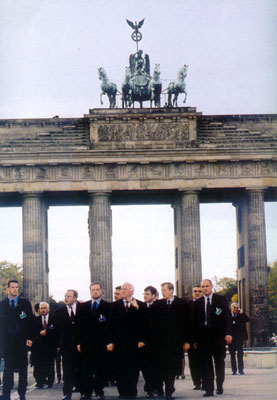
In Moscow, we met in his flat, like we had so often met in Bonn in his days as Foreign Minister when I hosted him in my home. I could sense how much Georgia’s fate was on his mind. He asked, “What would you do if you were me?” He was being asked to return to Georgia. I told him, “I would accept the invitation. And I know that you have already decided to do so. When I visited your country, I realized how much Georgia meant to you. Like you understood how much my country which you gave back to me meant to me.” Thus, he went to Georgia when the country had virtually no prospects.
He agreed to accept this mission at a time when he could not possibly
have known whether he would succeed in coping with those problems.
Today’s award is also a recognition of his statescraft. It is an expression
of Germany’s gratitude to this great man. But we owe a far greater debt.
If we want to recognise him for what he has done for Europe, then Germany,
as the heartland of Europe, must assume the responsibility of eliminating
the remaining confrontations on this Continent.
We the Germans can thank Shevardnadze by helping his Georgia, which is now travelling the difficult road toward democracy and a market economy.
We want to help this country, one with which we have such close bonds and with which we have always maintained cultural and historical contacts. We want to help it on its way toward Europe, of which we have always perceived Georgia to have been a part.
Giving this award is not only a tribute to the European statesman, Eduard Shevardnadze, but an expression of our gratitude to this great Georgian man. Today, I congratulate this man. I am proud to be his friend. I present this award to Shevardnadze the European, and Shevardnadze the Statesman.
I congratulate the man to whom humanness is so dear. And the new Europe, for which he has done so much, must be similarly humane.
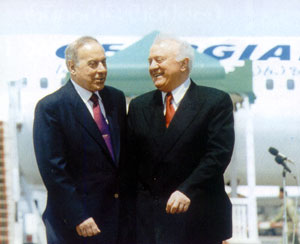
Heidar Aliev,
President of Azerbaijan
The friendly relations between Georgia and Azerbaijan and the documents signed by our governments that determine the strategic nature of our relations have great significance for strengthening peace and stability in the South Caucasus and the Caucasus at large. Georgia and Azerbaijan are the largest independent states in the Caucasus. They have very advantageous geopolitical location. I am glad that Eduard Shevardnadze has the correct vision for our region and attaches great importance to the role of our partnership.
Eduard Shevardnadze, a great statesman, is at the same time a very down-to-earth and cordial man. I am happy that our long friendship has acquired a new significance - one which facilitates and helps us to address many important matters.
My appreciation for President Shevardnadze’s tireless energy and the sacrifice he makes of himself for the good of his people gives me reason to believe that he will do even greater things to strengthen and develop the independence of Georgia.
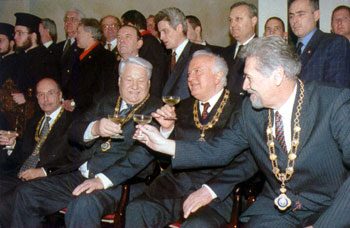
Boris Yeltsin,
President of the Russian Federation
Eduard Shevardnadze has a remarkable ability - he
makes you respect him.
Remarks BY President Shevardnadze at the Flag Raising Ceremony at the COUNCIL Of Europe in Strasbourg
April 27, 1999
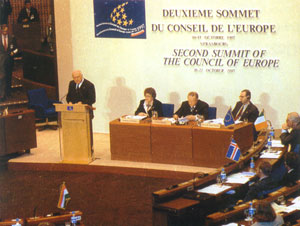
Ladies and Gentlemen
To say that I am merely excited would not be fully accurate. No longer am I a young man, so I have mounted many a podium and I am used to addressing various audiences world-wide. But this time, my heart is bursting with emotion. I find it difficult to express the sense of joy and responsibility that overwhelm me now. This is perhaps because I am not speaking on behalf of my generation alone. I feel as though here in the center of Europe, the spirits of my great ancestors are hovering here above us, and that I also speak on their behalf. Today, the dream of all generations of Georgians has come true, and Georgia has become part of the European family. I thank you, God, that you have brought my people’s centuries-long dream to pass.
I represent a nation whose many generations dreamed of becoming one
with the European civilization. Georgian culture, our value system, and
even social order in medieval times were essentially European - although
the peaks of Asian thinking were not out reach.
| “Time has a remarkable feature. It gives new
light to past events. It shows their true worth. It clearly reveals the
deeds of years gone by and provides for their accurate assessment.”
Eduard Shevardnadze
|
My great ancestor, the Enlightenment figure, Sulkhan-Saba Orbeliani, here in the beautiful capital of France, was received with respect and care at the court of the Sun King, Louis IV. Then France and Europe did all they could. Georgia, however, was too far from Europe, and Europe was too far from Georgia.
Now, I address you, the children of my long-suffering homeland. It is our generation at the end of the third millinium of our heroic history that must shoulder the burden of the dream come true. Accession to the Council of Europe is at the same time a great responsibility. For our country, membership in the European family means the protection of human rights, the rights of our national minorites, and it means proving daily our independence, since the European Community is a community of free nations.
A few minutes from now, the Georgian flag will be raised in front of the Parliamentary Assembly of the Council of Europe. Our flag reflects the heroic history of our nation. I want every participant of this ceremony to understand clearly that what is happening now is a triumph, the crowning achievement of the centuries-long struggle that a small but highly cultured nation waged to protect its language, its homeland and its faith. For a long time, Georgia served as an outpost and a citadel of European civilization. This flag has never been lowered. It is still flying as a symbol of eternal aspiration of a nation toward happiness and feedom.
On behalf of my country, let me thank all of those who noticed and recognized
Georgia’s noble aspiration and did all to restore historical justice.