C.V.
David O. Lordkipanidze
Born in Tbilisi, 1963.
Head of the Geological and Palaeontological Department of the State
Museum of Georgia.
Father: a world famous Georgian archaeologist. David was therefore involved
in excavations and field-work since his childhood. Later on, he attended
the Geography and Geology Faculty at Tbilisi University and then became
a senior lab-assistant at the Academy of Sciences’ Institute of Geography.
Institute of Geography, The All-Union Academy of Sciences, Moscow:
Postgraduate studies. In 1992 he completed his dissertation on "Primitive
Men and the Peculiarities of Environmental Interrelations in Mountainous
Regions".
Why Palaeoanthropology?
D.L.: "Because I love detective stories since childhood...As for the
human evolution, it’s an entangled and complicated novel to explain. Also,
I saw French children enjoying themselves in the Natural History Museum
and I became envious… I wanted Georgian children to be able to play in
a museum like that.
Palaeoanthropology is the study of the historical origin of the human being. It is a science that developed after Darwin’s era. From its inception until the present day the many relics of human existence that have been discovered represent a great phenomenon.
On May 12, 2000 many world news agencies spread the following information: "A relic of the first human migration has been found in Georgia…" And the world press made a great fuss. Some experts said that it was the biggest event to occur in the field in the last 25 years, i.e. since the discovery of "Lucy".To cut a long story short, after Africa, the example discovered in Georgia is the human being’s earliest ancestor. You probably all know about the discovery of a Neanderthal man’s skeleton in Germany, as well as Pithecanthropus on Java, or Sinanthropus in China. However, over the last 50 years the epicentre of palaeoanthropological research has moved to east Africa. The amazing Leakey family discoveries completely changed the theory of human evolution. This was followed by the discovery of Australopithecus "Lucy", recognised as the earliest direct ancestor of human beings.
Today, the number of palaeoanthropologists far exceeds the remains of interred human beings and each new finding results in more discussions. They argue about every morphological sign and biological classification. However, today everybody concurs that our biological ancestors, the first hominids, originated in Africa and lived on that continent for a long time.
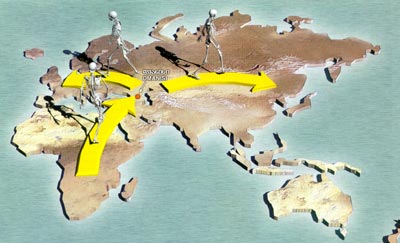
When and why they spread throughout Eurasia remains a constant subject
of debate. According to the idea that has dominated so far, the first Homo
to move to Eurasia around 1 million years ago, was from the Homo Erectus
group. Their move outside Africa is explained by progress in the technology
of stone tools, the so-called "Acheleyan Culture". The Dmanisi discoveries
therefore provide completely new answers to the question of when and why.
C.V.
David Lordkipanidze has been the head of department at Georgia’s
State Museum and a member of the international editorial board of the Journals
- "European Prehistory" and "Eurasia: Archaeology, Ethnology and
Anthropology" - since 1997.
D.L.: "On the basis of new data we believe that humans started moving outside of Africa at least 1.7 – 1.8 million years ago, when they still used very primitive tools. The stone material found in Dmanisi studied by Ms. Medea Nioradze’s team, is identical to the archaic material found in Africa that is believed to date back 2 – 2.5 million years. Morphologically, the Dmanisi Hominids are directly related to the early African Homo. Leading world experts agree that these are the first relics showing African characteristics to be found in Eurasia.
What was it that made human beings move outside of Africa? I do not believe that man was "thrown out" of Africa. It only happened because he was able to travel and wanted to cover new territory. I assume that physical and biological factors also exercised an effect. The adaptation to the new environment required when the Hominids moved from the woods to environmental savannahs also caused some anatomical changes. The size of their bodies and the volume of their brains increased, their bodies needed meat, an energy-rich food. As the Homo became a meat-eater, i.e. a carnivore, its natural habitat expanded.
Who are the Dmanisi Hominids? Relics of his ancestors were found only in Africa. They came to Georgia via the Near East and their descendants dispersed from Georgia in the direction of both Europe and Asia.
What did they look like? Females were approximately 150 centimetres tall (calculated from the foot bone found in Dmanisi). The morphology of the skull is quite different and the brain is almost half the size of brains nowadays. The Dmanisi Hominidae used to make stone tools. They probably used fire as well, although no trace of this was found in Dmanisi. At that time there was a savannah-type landscape in Georgia, but the climate was more humid and there were greater water resources than in their native Africa. The bones found in Dmanisi show that some sabre-toothed tigers, giraffes, rhinos, elephants, ostriches and other animals lived in Georgia. The Dmanisi human being seemed to do some gathering and hunting of small animals. However, he also made use of the hunted carrion of big animals. The existence of sabre-toothed tigers was therefore advantageous as well as dangerous.
C.V.
In 1998 David Lordkipanidze organised an exhibition depicting the History
of Georgian Nature in the State Museum. Between 1999 and 2000 he was involved
in the development of the scientific concept for the exhibitions
in the Paris Human Being Museum and Tautavel. Since 1999 he is a member
of the International Committee for the Renovation of the Paris Human Being
Museum.
Discovery, in general, is a strange phenomenon. In fact it may be by chance, an apple may suddenly drop on your head or you might stumble over a stone. The point is to stop and find out what kind of stone you stumbled over… And a further point, nothing happens by chance in the World. That also applies to discoveries. A discoverer is an individual who deserves his achievement as a result of his deeds, devotion, desire and aspiration.
D.L.: "Excavations have been carried out in Dmanisi for several decades. At other times the excavations were headed by well-known Georgian scientists Levan Muskhelishvili and Vakhtang Japaridze. Mr. Jumber Kopaliani leads the excavation work at the present time. In 1983 Professor Abesalom Vekua discovered a rhino’s tooth in bones found in middle-age pits, which with some other relics discovered in the same year, enabled him to ascertain the geological age of those layers as Early Pleistocene (the geological epoch around 1.5-2 million years ago).
From 1984 the works continued at a higher intensity and a new era started in Dmanisi in 1991. It was during this period that the lower jawbone of the Hominids was discovered. This coincided with the involvement of German colleagues in the project, facilitating the expansion and international recognition of the Dmanisi works".
On May 12 of this year the most authoritative scientific journal in
the World – "Science" dedicated a series of publications to the Georgian
scientist’s discovery.
How many scientists are there in the world, and how many of them would
like to find their names in "Science" at least once during their lifetime?
After the article was published the world scientific society finally
came to share the opinion held by Georgian scientists for 10 years: the
relics of human beings found in Dmanisi are around 1 million 700 thousand
years old, and according to present-day data they are not only the oldest
in Europe but anywhere outside of Africa…
The publications of "Science" were followed by some articles in the
"New York Times", "Washington Post", "Time Magazine", "Newsweek" and
"National Geographic".
D.L.: "In December 1991, I was lucky enough to be able to attend the International Forum in Frankfurt with Professor Leo Gabunia. The Forum was dedicated to the 100-th anniversary of the discovery of the Java Pithecanthropus, and almost all the world-famous palaeoanthropologists attended it. The reaction of the conference participants to the Dmanisi lower jawbone made an impression on me that will remain with me for the rest of my life. The reaction of a palaeoanthropologist to an original article is another subject. It’s difficult for me to describe the feelings reflected in the eyes of so many well-known palaeoanthropologists when they saw the Dmanisi skulls! Many great palaeoanthropologists have ended their careers without participating in the discovery of interred human beings.
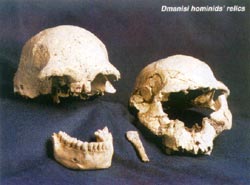
Leo Gabunia’s claim, first made in 1991, that the Dmanisi lower jawbone belonged to the African group of Homo Ergaster remains unchallenged. This opinion and the idea of a Dmanisi age, was not shared by many scientists at that time. Their main argument was simply - "It is impossible". However, it must be noted that it is not easy to introduce revolutionary ideas in the conservative world of palaeoanthropologists, even more so, when these ideas belong to someone from a small country. In general, the lower jawbone and teeth are less easy to use for diagnosis than skulls. There is a popular saying among professionals, "Skulls were created by God and the jawbone is the devil’s product". Some foreign scientists at first said the lower jawbone was representative of later forms of human beings. The discovery of skulls in Dmanisi provided the final evidence for Mr. Leo Gabunia’s opinion and resolved the doubts of many scientists.
This finding was really a lucky discovery. We have a special program in the State Museum which aims to introduce students to our science. The program involves some field trips as well. During one of these trips, young scientists Gocha Kiladze and David Zhvania, took a group of students to Dmanisi. Gocha noticed something suspicious in one of the pieces of washed rock and took it back to Tbilisi. It appeared to be the fragment of a skull, but it was difficult to determine what kind of skull it was.
Mr. Abesalom Vekua’s initial judgement did not betray him, and on May 31, 1991 the first skull of an adult man was discovered. The second one, belonging to a young woman, was found on July 22 after systematic excavations. The first person to touch it was a young scientist Giorgi Nioradze. In 1991 the scale of research in Dmanisi was expanded significantly and American, French and Spanish colleagues got involved.
This is how Georgia came to be at the centre of World science.
The most prestigious publications do not hesitate to print the most delightful statements:
"Georgia is the country of the first Europeans and the discoveries of Georgian scientists put the age of the first Europeans at twice what we formerly thought" (from "Le Monde").
"Two simple skulls whose value exceeded gold bars put all the world’s pre-historians on the edge of their seats"… (from "Liberation").
"The Georgian discoveries have resolved the Spanish-Italian conflict about who was the first European" – wrote the "Figaro" newspaper.
C.V.
David Lordkipanidze carries out field work in Gareji, Dmanisi and in
the caves of western Georgia.
He is the co-ordinator of the Dmanisi and Gareji International Projects.
He is the author of approximately 50 scientific works which have been
published in Georgian, Russian, English, German and French.
D.L.: "These achievements are the result of the work of the entire group.
Today, science can be developed through inter-disciplinary and international
co-operation. Many people have the impression that palaeoanthropology is
a romantic profession, but believe me, it does not only mean excavations.
It is research in which both traditional methods and the latest achievements
in natural and precise sciences (in particular, nuclear physics and molecular
biology) are applied."
The only word that you hear while speaking to David is "We". And we
are very proud of the people included in that "We".
D.L.: "By the way, I experienced the greatest joy in my life on July 22, 1999 when Mr. Jumber Kopaliani, head of the Dmanisi Department of the Archaeological Research Centre, notified me by mobile phone of the discovery of part of the second skull in Dmanisi. I left immediately for Dmanisi the happiest man in the world. Therefore, this "Magti" call is connected to the most significant event in my life.
After the publication in "Science" there was an unbelievable barrage of journalists. It became the main topic on BBC and NBC. They were constantly contacting me for information. At that time I was involved in some excavation work in the Gareji area so was only able to give my interviews by mobile phone. The journalists expressed some doubts about the quality of information they would receive over a mobile phone, saying that it might not satisfy them. I explained that the quality of the Magti GSM connection was very good and they would not have a problem. My promise held true and the interview was put on the air.
In 1999 the LeakEy Foundation sponsored our project to carry out some research work in the Garedji area. In November a relic of a primate aged between 8 and 8.5 million years was discovered. It is the latest example of the anthropoid ape (Dryopithecus) which remained in this area 1 million years later than on other territories. It has been shown that in different geological epochs Georgia’s territory was characterised by its favourable natural environment for primates (and maybe for human beings as well). The extinction of different species took place later here than in other areas in Europe."
That’s how our native land is. It turns out that Georgia is of such importance, and that it is not only a place of meaningless words where we hit our fists against our chests holding a glass of wine. And we shall look at these discoveries, the scientific research and its world-wide importance not only with joy, pride and delight, but with careful judgement and full recognition of our national responsibility.
What is the role and mission assigned to Georgia by God? What is it that we should think about and defend? Is it only investigating the past, or can these discoveries also impart something significant to the present time and our future point of view…
The research in Dmanisi and its surroundings led by Professor Leo Gabunia is continuing and expanding… At the current time Dmanisi represents the most significant testament of mankind. Now the Curriculum Vitae of human beings is being written there as well.
MARINA VASHAKMADZE