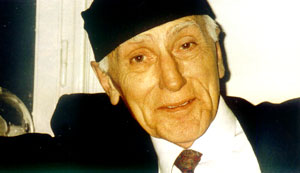
"Chabua nervously collected the sheets of the manuscript and murmured: ‘Who knows what will come of it!’
This wasn’t meant merely to be a pose or a gesture to find out what the others thought of it. It was an earnest doubt…
Now everything seems to be very easy…
But at that time a weak, dim ray of light penetrated from the frost-encrusted window. The man who had much to say was having trouble uttering a word - he was seized by doubt, distrust and hopelessness. And yet, stubborn confidence was his support in those days and so was the inner steadfastness tempered by his many years of life experience and the reversals of fortune. It can’t be that all vicissitudes fall on the head of one man… Perhaps it is also the adventurism inherent in the blood from ancient times, passing on from one generation to another and always accompanying the life of a commander-in-chief, a traveler and a writer…" This is what Otia Pachkoria, a writer and Chabua Amirejibi’s closest friend wrote about him. At that time "Data Tutashkhia" existed only in the form of a manuscript, but as far as the writer’s life is concerned…
His parents and close friends fell victim to the purges of 1937, followed by sixteen years spent in a Soviet jail. Three escapes from prison, two death sentences and ultimately, rehabilitation – all these events were reflected in his book "Gora Mborgali". With his creative works, his ancestry, his past and innumerable hardships that had fallen to his lot, today Chabua Amirejibi, quoting the words of the same friend of his, "is a man who has come from the legend" and is himself the character in a huge and exciting book.
Mr. Chabua, who played a critical part in the formation of your personality and influenced your becoming a writer? What was the role of the time (Soviet period) and aristocratic discent in this process?
First and foremost, my grandmother - Sopio Magalashvili-Amirejibi, my grandfather - Giorgi Amirejibi, my parents and Mrs. Melania Medzmariashvili-Gvelesiani, academician Guram Gvelesiani's grandmother. Mrs. Melania was a Sorbonne graduate with a specialization in pedagogy. How did it happen that I found myself in her family? I was a very mischievous boy and my parents implored ‘aunt Melasha’ to receive me at her house and, finally, she agreed. In almost every interview I underscore how much this person had contributed to the formation of Chabua Amirejibi’s personality. At the age of six, I became her pupil and when I turned eight, I was admitted to the second grade. Two years were sufficient for this brilliant person and teacher to implant strong moral principles in the character of a boy. It occurs to me that if it had not been for those two years, I would have become an entirely different man – much worse a person.
As for the role of the time. The time was extremely hard. I recall very well, how sitting around the table at dinner my father, Irakli, and my grandfather, Gogi, exchanged news of the stories of arrests and shootings of various people. As for the family influence – fine manners, self-control, politeness and love were the sources and key elements of my upbringing.
What were your first literary endeavours? What is it that you remember most of all?
Three years ago, the Kavkasioni newspaper published a verse (that was found in Batumi) which I composed at the age of eight. The skill of composing became apparent in me from early childhood. At the age of twelve and thirteen I tried prose as well. One event stuck in my memory: my sister, Rodam, and Lali Javakhishvili were the history faculty students of the University and used to study their subjects together at our place. Once, when I returned home, I saw them reading a story that I’d written. Lali praised me: "A very good story", he said. It seems that those words of praise have also contributed to the fact that I never stopped writing.
How do you work? Is there a rule that you always follow when writing?
Usually, I write slowly. I don’t think it’s possible to write a big book at one go. Obviously, I mean writing a good book. My manner of writing is like this: when I have thought over and ‘visualized’ my future book from the beginning to the end, I start writing a piece which I feel like describing at that very moment. It could even be the ending. Having written the piece, I put it aside, and if in the meantime another bit doesn’t demand to be written, I get back to the written one in a fortnight. I either make changes to it, or sometimes I throw away what I have written. It might also be that the piece doesn’t even require minor changes. This shows why it took me ten years to write one book. I must also note that for ‘visualizing’ the book, my whole past life is necessary. I write what I know. And what I know is something called life experience and what I’ve thought about.
What were the complexities that the writer and the ordinary citizen - Chabua Amirejibi managed to overcome in the Soviet period?
In April 1944, as a member of the illegal organization ‘White Giorgi’, along with the other 19 members, I was sentenced to 25 years of imprisonment by the Security Army Tribunal with the accusation of preparing an armed uprising. The Extraordinary Affairs Prosecutor thought the sentence was insufficient in my case. He filed an appeal, asking for the death penalty. I spent seventy-five days in a cell with prisoners sentenced to death. I wasn’t executed eventually, but the former 25-year verdict was retained. From that time on, the ‘series’ of my escapes began. In the process, I managed to ‘earn’ another death sentence. With all the sentences added together, the period of my imprisonment totaled 83 years. A close friend of mine, Otia Pachkoria, used to say that after ‘the rehabilitation’ I left those 83 years to the Gulag and went back home.
It would be interesting to know how you managed to communicate with the bureaucracy and the authorities? Or were there officials like Count Sedegi at that time as well?
Let me tell you that in Georgia at the time of my return, except for some rabid idiots, there were very few people among Georgians who were ‘crazy’ about the idea of Communism. When I came back, the people of my generation held the reigns of government of the Republic in their hands. I would like to take this opportunity to thank them once again for the support and help they gave me. And as for the reason of ‘being unable’ to communicate with the authorities prior to my imprisonment, I’ve indicated it earlier.
How did you manage to publish "Data Tutashkhia"? Did you encounter any problems with censorship? If one of your characters is to be believed, censorship only fights against "the grey one".
The character you mention implied a lack of talent with a pretension of being gifted. As distinct from "Gora Mborgali", "Data Tutashkhia" encountered severe censorial obstacles. A semi-official critical paper accused me of insulting Russia and Russians. But first, let me tell you about the publishing problems. Having finished the book, I took it to the ‘Tsiskari’ publishing house, put this enormous pile on the desk of Jansug Charkviani, the editor-in-chief, and told him: "Jansug, please read this for fun together with your editorial staff. I doubt that you’ll have it published but I’m sure that after fifteen years this book will be a winner. Givi Gegechkori, Tariel Chanturia, Otia Pachkoria and Jansug Charkviani - all read the book. They submitted the first part of the book without the censorship. Publishing was suspended. Many noteworthy events occurred then. For instance, the novel was forwarded to the security service for their response. The Gulag was again threatening me, but the truth triumphed. This is how it happened: Nika Cherkezishvili was the head of the Agitation and Propaganda Department at the Central Committee of the Communist Party. Having read the novel, he requested the late Otar Kinkladze, an outstanding citizen and a patriot of his country, to read it as well. Then, with the agreement of the first man – Eduard Shevardnadze, he sent the copies of the book to twenty or twenty-five writers to read and provide their opinion in writing. Nika and Otar accompanied Mr. Shevardnadze on a holiday with another copy of the novel under their arm. After spending nearly a month in the sanatorium, they came back. Mr. Shevardnadze had already read the novel and all twenty responses from the writers were lying on Nika Cherkezishvili’s desk. Then something that had never happened in Georgian literature before occurred: Eduard Shevardnadze offered "the operational issue of the ‘Tsiskari’ editorial board" to the Central Committee Bureau for consideration along with his own opinion and received a positive response. The novel found its way forward, there was nobody who would dare to object and the persecution was over.
How did the critics and the readers receive "Data Tutashkhia"? How successful was the screen version of the novel? Did you participate in the shooting of the movie?
Both the readers and the critics (including official criticism) welcomed the novel with tremendous praise and laudation. A great many reviews were written and talk went on about the need to make a screen version of the novel. I also recall that when it was presented for the Rustaveli Prize, "Data Tutashkhia" failed to become a winner – due to the ideological circumstances of that period and the stereotypes established in literature.
The issue of shooting a movie based on the novel gained momentum. Giga Lortkipanidze and Gizo Gabeskiria took on the film directors’ responsibility under the sole condition that I would be the scriptwriter. The movie was intended as a serial for a television broadcast. The Committee for Radio and Television agreed to provide the funding. "Georgian Film" started shooting the movie. The director of the studio (for the second term) was Mr. Akaki Dzidziguri. The movie followed the script faithfully. Participation of the scriptwriter is essential in the course of film-making because the necessity of introducing changes or adding something always arises at all stages of shooting.
Is the book "Gora Mborgali" an autobiographical novel and how accurately is that period of time reflected?
As I’ve already mentioned earlier, the writer writes about what he has acquired from his life experience. I’ve written based on my fundamental knowledge, what my friends and I had experienced. Recently, Tariel Chanturia told me: "Write a book in the form of an autobiography, reminiscences, memoirs - call it as you wish." "Read "Gora Mborgali", I replied.
Indeed, documentary accuracy has been entirely observed in "Gora Mborgali", with the exception that I have altered the names of some of my heroes. Following the insistent requests of my wife, Tamar Javakhishvili, we have compiled a sort of "Who is who" of the novel that we’re going to attach to the next edition. When I say precision has been observed, I mean that whatever I include in my work is precisely based on what my analysis and my memory have perceived.
You have translated "Data Tutashkhia" into Russian yourself. Into what other languages are your works translated? Taking the whole period and the situation into account, how is Chabua Amirejibi known abroad?
Both "Data" and "Gora" are my translations. Of course, I worked on them having the interlinear translation prepared by others. My works, the novels in the first place, have been translated and published in nearly thirty languages. Please, don’t make me list them - it will exhaust both the reader and me.
Every foreign edition has the key data of my biography attached to it, with a promotional purpose, I suppose, for the reader to familiarize himself with them. And this is how they know me.
Today, there is a lot of talk about voluminous novels having exhausted their capabilities. How do you view the future of the novel?
It depends on the novel. A book should be written in such a way that makes the reader switch off the TV. My both novels are thick – did you find it difficult to read them? However, you’re right in saying that the future of the novel is associated with smaller volumes. Today, when the atmosphere is overloaded with information, a person has less time to read thick books. I’ve taken this into account for my new novel. It’s going to be at least two times smaller than the previous two.
In your opinion what is modern Georgian literature like? What can you say about the young writers? Who do you know and for whom would you predict a bright future?
Contemporary Georgian literature is on its way to flourishing. Young writers successfully carrying the literary burden have emerged. I have big hopes and expectations for them. Don’t make me list their names. I don’t want to name someone in the first place and someone in the last. As a rule, a writer sharply reacts to this.
Who do you consider to be your literary heir?
He who will write better than I do. There will be more than one of this type to appear.
Why have you decided to found a newspaper? What do you wish to tell today’s Georgia by means of this newspaper? Couldn’t the same message be communicated through literature?
I decided to found a newspaper which would target the truth, be unbiased and serve a neutral readership. This idea became a winner like my novels and journalistic works on current affairs, especially since I have a group of like-minded people in the editorial board headed by the well-known writer Vazha Gigashvili.
What can you say about contemporary Georgia?
It could be said that Georgia today is indeed not the Georgia of today. Due to certain circumstances, it is a repeat of previous ‘Georgias’ with one difference, the person of Eduard Shevardnadze. In him, it has a worthy, inexhaustible and a far- sighted leader recognized all over the world. Such luck has very seldom fallen to the earlier ‘Georgias’. Personally, I am a ‘Shevardnadze-ist’, and whatever the future turns out to be, my position shall always remain the same.
Have you ever thought of leaving this country?
When visiting various foreign printing houses, such proposals have been made, and included fairly sizeable sums. But I am not a man to leave my homeland for any kind of offer. Especially today, nobody could be able to drive me out by force. There is so much to be done… I can’t become a deserter.
Mr. Amirejibi, what are you currently working on?
I’m writing a new novel with the working title "Giorgi the Brilliant",
which by its form, concept and main features will be different from the
preceding ones. I don’t want to say anything in advance because the outcome
doesn’t always correspond to the initial idea. Let’s see what turns out.