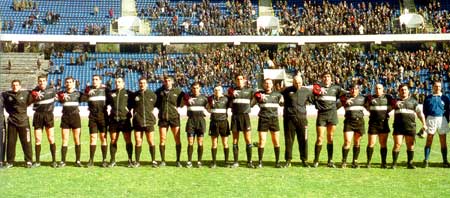
Rugby, played between teams of 7 players, was the first sports game in which Georgia made it to the finals of a world championship.
The first serious success of Georgian rugby players was the victory in the match with the Russian national team in 1997. At that time, the game had also a different meaning. It was not just playing rugby.
The twenty-first century began with two big victories for the Georgian
rugby players: the national team "Borjgalosnebi" snatched the European
Cup from Romania, and the youth team won the finals in the "B" group at
the world championship in Chile. It also won the cup, and starting next
year they will be struggling with the strongest teams of the "A" group.
Some stories about the oval ball lovers
They say that human beings started playing ball from the cave-man age. Numerous versions exist about the object that was used instead of a ball, or how the first ball was created. Yet one thing we know for sure: the ball was played from ancient times and many games originated from it, e.g. football, soccer, basketball, volley-ball, water-polo and so forth... There are a lot of rules and definitions and there is a vast number of players and fans…
Georgian Lelo belongs to one of the group of games whose history dates back to centuries BC, and continues up to today. A new Rugby Encyclopedia was recently published in the United Kingdom which indicates that contemporary rugby originates from Georgian Lelo. Researchers will probably clarify how and from where this game got spread throughout Europe. But before that happens, what we know today is that in the early nineteenth century, in the English town of Rugby, William Web Ellis, a college teacher, caught the ball while playing soccer and ran, holding the ball in his hands, until he reached the opponents’ gate and thrust the ball into it. Soon "this avant-gardist soccer player" was joined by the like-minded people, the shape of the ball was modified and special rules for a new game were adopted. By the end of the century, the International Board of Rugby was set up.
If one is to trust the Georgian press of the time, the sailors of an
English vessel in Batumi played the ball "just like we do", and very often
they did so together with our folks. In this regard, one of Boris Paichadze’s
stories is of note. He described how the English sailors were playing with
a strange, oblong-shaped ball near the
Poti Port (the Poti residents thought it was a melon) and with what
ease the Georgian guys who played Lelo mastered the game…
In the beginning of the twentieth century, the first serious championship was held in Europe which was called the "Five Nations" championship (England, Ireland, Wales, Scotland, France). It took Italy nearly a century to be granted the right to take part in this most prestigious tournament. Today, this championship is known under the name of "Six Nations". The Rugby World Championship, first held in 1987, and the championship of the "European Nations' Cup" are also among the very important international tournaments.
This "bourgeois game with a rather dubious origin" was not popular in the Soviet period. Rugby came into official existence approximately in the fifties of the twentieth century. The first Georgian team was formed in 1959. Subsequently, the Rugby Federation was also established. Throughout many years, Georgian rugby players represented a strong force in the Soviet Union’s national rugby team, and several times Georgian teams were the winners of the Soviet Union Cup.
In the nineties, the independent Union of Georgian rugby became a member
of the International Board. Since that time, the newest success of Georgian
rugby began.
Today in Georgia there are: the National team, the National team of
seven, and the combined teams of the age of twenty, nineteen and seventeen.
Six teams play in the highest league of Georgia. Likewise, there are six
teams in the first league participating in the Georgian championship. There
are also "A" and "B" youth leagues.
For children, annual rugby festivals are held. Kids start playing rugby
from the age of 8-9 and some carry on until the age of 40-45.
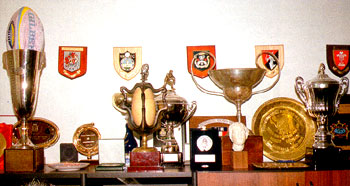
"A barbarous game" and Georgian "knights"
Once, a famous English football player Bob Charlton said: "Rugby is a barbarous game and knights play it. Football is just the contrary – it is a knights’ game and barbarians play it."
The majority of the Georgian National team members, the so-called "Borjgalosnebi", are legionaries playing on various French teams. They come to Georgia for international tournaments and also in the summer – on vacations. This is the period when the members of the National team manage to train together. At this time, the office of the Georgian Rugby Union is always crowded with people and the most interesting days begin.
Ilia Zedgenidze - 24 years old, number eight, the third line of combat. Graduated from the International Law and International Relations Faculty at Tbilisi State University. Has been playing in France since 1998. He has five weeks a year for vacation, which he spends in Georgia. He is willing to start scientific research next year, and to spend all his spare time working on his dissertation.
"Rugby is an interesting and courageous game. To be a good player, one must have knowledge, experience and sound technical skill.
My friends played rugby and got me into it as well. I was 17, a first-year student. First, I played in the "Rashi" team, and then I changed teams several times. Now I am in "Toulon". It's a professional team. For the upcoming year, Gia Labadze, Besik Khamashuridze and Akvsenti Giorgadze will play together with me. We're old friends and all of us play together in the national team of Georgia. It is a great privilege when you're not "alone"…
In France, there are all the conditions that help you to develop to the utmost and play serious rugby…"
Vaso Abashidze - 23 years old, the outer-line runner, the rear line. Played three months in France. The match of the Georgian national team coincided with the match of the French team, and he had to make his choice. That became the reason for leaving France. Currently, negotiations are underway with one of the "Elite-2" clubs.
"Rugby is a very difficult but very interesting game.
It's a family sport for me. My father was a rugby player and so was my uncle. I've been playing since early childhood. First I played in "Lelo", then I went to Holland, came back and continued playing in local teams. Then I spent three months in France and it so happened that I came back from there. I couldn’t do anything else – I couldn’t refuse to play on the Georgian national team. It is very difficult to be in good shape in Georgia. And you can't live on the pay here. If, however, you start doing something else, you won’t be able to play rugby any more. After a while I want to go to France again. Let’s see what happens…"
Gia Labadze – 27 years old, number 7-8, the third line. Has been playing in France since 1997. He lives in the coastal city of Toulon, and when he is back in Georgia, he does not want to look at the sea. Instead, he intends to spend his holidays in the mountains and get a "good" rest.
"Rugby is a cool game – it's a collective effort, very friendly and intellectual. Everything is figured out, it's not just throwing the ball here and there, and not only that you must grab the ball and run. One mistake and you might lose the entire game.
I used to play football first, but it didn’t work out. Then my brother-in-law advised me to switch to rugby and I listened to him. First I played in the boys’ team "Lelo", and then I was transferred to the Soviet Union national youth team. In 1991, I took part in the world championship. After that, I came back to Georgia. Then Russia again, and in 1995, for the first time, I was accepted to the national team of Georgia. Afterwards, it so happened that I found myself in France. I played alone for a year, and then Ilia Zedgenidze arrived. It is extremely difficult to be alone there, and I am immensely happy that from next season there will be four Georgians playing on the same team.
Many things happen in the course of the game. At that very moment, you might get very angry. Once, when playing in Italy, I was lifted up to the outside. I was above, then I threw the ball and immediately they let me go. Everyone ran after the ball. I’m still in the air and then, suddenly, bump! On the ground I am. When watching the tape afterwards, I nearly died of laughter. It was funny to watch how I " landed" on the ground from that height…"
For Georgian rugby players, playing on the foreign teams appeared to be the only way of keeping in shape. The funds budgeted throughout the year for the Rugby Union were insufficient to cover the expenses of even one international game. If the scarcity of playgrounds and stadiums is added, it is easy to understand what effort is needed on the part of the Georgian rugby players to win.
The Georgian rugby community and the World Cup
At the third championship of the seven-man rugby, the Georgian national team won 10th place. After the fifteen Georgian players won the European Nations’ Cup, it is assumed that the Georgian "Borjgalosnebi" will be playing in the finals of the World Championship.
Since 1995, Bidzina Gegidze has been the Rugby Union president. Being an architect by training and a professional rugby player, he has been performing his duties for a second term. It is probably to his credit that the Georgian rugby community is so strong and unified. Over the last five or six years, many good players have returned to Georgian rugby. Nearly disintegrated teams were reunited. Annual championships are held and one more thing – every match is attended by an enormous army of rugby fans.
Mikheil Burdzgla – executive director of the Rugby Union.
"According to the results of the first round, we are in first
place. We have defeated the Russians and Rumanians on their home turf.
A number of serious and very difficult matches are still ahead. We must,
by all means, win and reach the finals. We have a strong support from the
International Board of Rugby (IBR) and the International Rugby Association
(FIRA-AER). The situation has changed. Georgian Rugby has been recognized
worldwide and now, there’s no way to retreat…
Rugby fits remarkably well with the personality of the Georgian man.
It is a complicated game with complicated rules. The history of rugby has
not recorded any game where the outcome could have been "preliminarily
fixed". By the nature of the game itself, such a thing is impossible. If
other kinds of sports have exhausted themselves, meaning that everything
that could have happened on the field has already happened, in rugby, everything
is still ahead.
In November, the French national team is due to arrive in Tbilisi. Until recently, playing with a Georgian team meant nothing for France. This decision, however, means a lot."
France is among the strongest in the rugby world. France selects the best players from about five thousand, Georgia – from only a hundred. But as the saying goes, everything changes for the better. A day does not pass without someone calling the Rugby Union office to say that his son wants to play rugby, and requesting a recommendation of teams the parent should approach. The number of Georgian legionaries grows from day to day. They also keep saying that the land of Lelo may very shortly turn into a rugby country…
A strange, sportive life fell to the players of the twentieth century Georgia.
The success of Georgians in international tournaments in the past was considered the success of the Russians, whereas, in Russia, Georgians themselves were considered Soviet sportsmen. It took almost a century until our sportsmen could compete under the Georgian flag. As for Georgia itself, it had to be rediscovered on the world sports map.
Perhaps, in the twenty-first century, Georgia will not appear on that
map as small as it appears geographically.
At least, Georgian rugby players believe this is going to be the case.
ELISO KAPANADZE