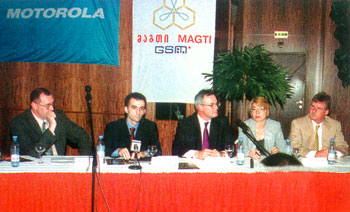
On July 26, 2001 MagtiCom announced the successful completion of the first General Packet Radio Service (GPRS) call within its wireless network in Georgia, using Motorola’s end-to-end solution.
A large number of people gathered at the Metechi Palace Hotel for the event - those who are interested in progress, new technologies and future prospects.
The presentation was attended by the special guests from Motorola:
Kevin Lousemoore - Corporate Vice-President and General Manager, EMEA
Michael Leahy - General Manager Europe/Asia
Alex Gechtman - Operation Manager Russia, CIS, Central Africa
Alex Uporin - Account Manager Europe/Asia
Steven Novak - Technical Services, Emerging Markets Network Solution
Division
Levan Vachnadze - Project Manager
The history of Motorola begins from the 1920s and reflects many changes taking place in the electronics industry. It all started in 1928, when the Galvin brothers purchased a small factory and started production of radio facilities. The brand name Motorola appeared on the market after the factory began to produce radios for motor vehicles. In the 1980s, Motorola started to produce pagers and mobile telephones. On January 3, 1996 Motorola made an official statement on the production of a new type of handset that was the lightest and smallest model at that time. Motorola’s ‘Startack’ weighed 90 grams and created a new standard in size: "Motorola has done what no one thought possible". Today, Motorola is one of the world’s largest businesses with billions of dollars turnover and thousands of employees.
Through its alliance with Cisco Systems Inc., Motorola is the leading worldwide supplier of complete end-to-end GPRS commercial network solutions. In 1999, the British cellular operator, BT Cellnet was the first company in the world to implement GPRS in its network using Motorola’s end-to-end solution. Magticom, which has over 165,000 active mobile subscribers and is the leader in Georgia in terms of coverage area, the quality of customer service and technological innovation, is the first operator in the Caucasus region to introduce the GPRS technology. With GPRS, users will be able to connect to the Internet in an on-line mode with data transmission rates of up to 115 kbps. GPRS will encourage the development of value-added services such as e-commerce, m-commerce and m-banking.
Motorola has been in partnership with MagtiCom since 1996, when Motorola was chosen for the MagtiCom network development. Currently, MagtiCom’s entire network is fully equipped with Motorola base stations. In 2000, Motorola and MagtiCom jointly started to work to introduce WAP, which is in full commercial operation today. With the completion of the GPRS project, Motorola has recognized MagtiCom as an important partner and intends to continue the introduction of the latest technology solutions into MagtiCom’s network.
"MagtiCom has been taking decisive steps to prepare for migrating to the next generation network technology. As Motorola’s important customer, it is among the few operators in the post-Soviet countries to have introduced complete GPRS solutions. Motorola is pleased to provide the infrastructure, applications, services and system solutions needed to support MagtiCom customers’ growing demands", said Michael Leahy, Motorola Global Telecom Solutions Sector General Manager for Europe and Asia.
Motorola’s Timeport 260 wireless phone offers consumers a constant link to the mobile Internet for smarter, faster and more affordable information. The phone’s tri-band feature gives users the ‘one-world’ phone option. Additionally, the phone features a voice activation modem to access Intranet, Internet, and allows users to switch between the data mode and voice calls, and synchronize data between phone, personal computer and other devices. Motorola’s Timeport 260 phone is the first commercially available triband GPRS phone in the wireless industry.
The GPRS presentation at the Metechi Palace Hotel has demonstrated once again that MagtiCom continues to be in the forefront of modern technologies.