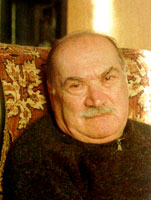
Mr. Jansugh Charkviani is seventy.
Seventy years full of many dramatic and sometimes even unbelievable events.
Jansugh Charkviani is a representative of the generation of writers who were not allowed to read Mikheil Javakhishvili and Titsian Tabidze at school. The generation that had something profound to say and established its own unique place in Georgian literature.
Jansugh Charkviani – a writer and a public figure. To be both a witness and a participant of historic events in Georgia was something that has fallen to his lot. In different years, he was the editor-in-chief of the "Tsiskari" magazine, director of the Sabchota Sakartvelo publishing house, president of the Georgian Pen Center and the author of many collections of poems that are full of enormous love and warmth…
The generation of the sixties. The generation raised in times of war and peace, providing an example of intelligence, bravery and chivalry; numerous stories of loyalty and love.
"Let me bring water to the thirsty…
Let me return the debt to the creditor…
Let me say: It was worth
living on earth…
Then I will come along and go
wherever you want me to go."
My generation belongs to the sixties. I don’t want anyone to think I am being arrogant when I say that Ilia Chavchavadze was also a representative of the 60s. A hundred years passed since then and Ilia’s generation was succeeded by ours. This was the "Pirveli Skhivebi" (first rays) and the "Tsiskari" generation. Conflicts between generations have always existed. But this has never been a conflict between personalities. Ilia’s generation had also fought against that of Grigol Orbeliani. But when Grigol Orbeliani died, Ilia deeply mourned him. How can I speak badly of the preceding generations that had paved the way for us to grow personally and professionally. Today, everything has changed. Unfortunately, this war between generations is understood differently by the new generation which fights with different aggressiveness.
I cannot say that my generation has done more than Galaktion Tabidze, Giorgi Leonidze, Mikheil Javakhishvili, Konstantine Gamsakhurdia and others did. I don’t think, however, that Chabua Amirejibi, Otar Chelidze, Guram Dochanashvili, Murman Lebanidze, Mukhran Machavariani, Ana Kalandadze, Lia Sturua have made any less contribution. Is there anyone who can forget Guram Rcheulishvili, Nodar Dumbadze, Rezo Inanishvili, Archil Sulakauri, Shota Nishnianidze, Vladimer Sikharulidze and many others… In my time, the circulation of the "Tsiskari" magazine was 70,000. Today, at most 300-400 copies are published. The present times have deprived us of books. Writers have no money. It is embarrassing to speak about it, but my last book was published nine years ago, not counting the 200 copies published by Merani three years ago. I was given a hundred copies instead of the royalties. The remaining one hundred are still lying on the shelves of the bookstore. Today the reader doesn’t have money either… The attitude toward national values has changed. A foreigner comes and takes your "Chakrulo" to launch it into space as the first, best and even divine. Whereas you, yourself… But all this is probably temporary.
"The family where he was raised was frequented by Jansugh’s entire generation. Here they learned that a good deed is an enormous wealth; that one is bound to give water to the thirsty, to return the debt to the creditor and never forget their brothers buried somewhere… Those who know Jansugh well, are aware of how many times he has given water to the thirsty…" (Tariel Chanturia).
My father was a man of a chivalrous nature, tall, imposing, a good toastmaster and very strict. Being an agronomist by profession, he used to hold important positions. At one time, he worked in Borchalo, where he infected me with enduring love of horseback riding. I was five and he would tell me, "Go and get a horse for me". The stable was rather far away. I would go there, where the shepherds would saddle a horse for me, mount me on it and let me go back. I was a kid and was scared to death. Time passed and the fear disappeared.
My mother was from the Gelovani family. She was a wonderful singer. They would put a chokha and a papakhi (Georgian national man’s overcoat and a hat) on her and would make her sing the lead voice in the choir. Her friends suggested that she should get enrolled in the conservatory, but my father was against it. That was at a time when the conservatory and the Theatrical Institute were thought of as "bold" institutions. Dad would come back home and start telling lies about robbers breaking into some home when none of the adults were at home, just the kids, and the robbers killing them… Mother decided that for the sake of our safety, it would be better for her to leave the conservatory, just to be sure there was no trouble at home when she was away. I believe my children have inherited my mother’s genes with their gift for singing. Whatever the circumstances of our life, sometimes cheerful and sometimes full of hardship, one could always hear singing in our family. What I remember most of all was an extraordinarily warm relationship between people - the neighbours, the family members, mere acquaintances and even strangers used to help one another. Nobody would ever see a beggar on the streets…"
"Jansugh Charkviani! Something childish and brave echoed in this name…" (Nazi Kilasonia).
In our childhood, we used to read Mikheil Javakhishvili, Titsian Tabidze, Grigol Robakidze secretly. Later, it became possible to read everything openly. Foreign literature also became available. I recall our teacher of Georgian literature, Mrs. Nino Sukhishvili explaining Vazha Pshavela’s poem "Khanjali" (sword) to us. She told me, "Jansugh, put your hands in such a way as if you were holding a sword". The outcome of this explanation was that, at the age of 12, my friends and I ran away from home to join the soldiers fighting in the World War. We had made arrangements with one stupid captain who agreed to take us as "the sons of the regiment". Someone, who refused to come, revealed our plan and our parents caught up with us in Mtskheta. On the way back, they treated us to Mtskheta pies and scolded us at the same time. I’ll never forget this experience. I am still proud that we, the 12-year-old boys, had enough courage and strength to do what we had done. I don’t mean to say that it is right for kids to run away and join the war, but it is important that they are taught works like "Khanjali" and "Gantiadi" (the dawn). They should be taught "Kvata Ghaghadi" ("The Story of the Stones") and then they will know how to live. At home, a child should be brought up by the family and at school – by the teacher.
I recall how happy we were to join the Pioneers’ organization. How proudly we used to walk with the red Pioneer ties on! I have a friend, Aleko Tskitishvili, who’s a wonderful person. We were in the same class at school. Both his mother and father were shot in 1937. The two little kids, he and his sister, were left all alone with no one to take care of them. Those were the years when such terrible things often happened. Well, all of us were standing in line, waiting to have our Pioneer ties tied around our necks for the first time. The teacher started reading the list. When she read out our names, we made a step forward. All of the names were read out, except Aleko’s, and his eyes filled up with tears. I looked at him and said, "If he isn’t accepted, I shall refuse to become a Pioneer". The teachers reflected on the prospect. He is a Charkviani, they thought, so to avoid any problems, they decided to accept my friend as well (Charkviani was the name of the communist party secretary at that time). Even today, when we meet, he often recalls that day, "You know, Jansugh, I wanted so much to become a Pioneer!"… Well, we were kids and wherever everybody was, we wanted to be there too. That was it.
"I am particularly fond of that mischievous boy who I can sometimes see awakening in Jansugh Charkviani’s eyes - a boy wearing green riding-breeches tucked inside his tightly-fitting boots, the shirt of the same colour hanging loosely over the breeches, and a thin belt with a silver buckle around the shirt… In the auditorium, he used to throw his hands widely apart, inviting different girls to dance with him. His talent is apparent in his poetic strophes, in his behaviour and in his manner of speaking. Everything suites him well, be it a poem, a song or a toast…" (Givi Gegechkori).
All of us: Givi Gegechkori, Zaur Bolkvadze, Tamaz Bibiluri, Otar Chiladze, Tariel Chanturia, Vakhtang Javakhadze and I studied in the same group at the Faculty of Journalism of the State University. We enjoyed a fantastic relationship. We went everywhere together and had great fun.
Irakli Abashidze was my father’s friend. He published my first book and we became friends after that. He was twenty years older, but we used to spend nearly all our time together. He never traveled anywhere without me. I was very close with Nodar Dumbadze, whom I always considered an extraordinary person that one must regard as an example. He was a man of incredible courage, had a very sharp sense of humour and an extremely bright mind. Giorgi Leonidze was another good friend of mine. Having read my early poems for the first time, he wrote on the top: "Very good, Jansugh!" Indeed, there used to be many great people…
"Hey, man! Twice when I nearly died and twice having come back from the other world, I saw you at my bedside with eyes full of tears and the trembling chin. How did you find out about my illness and how did you manage to get here so quickly? I’m trying to think with what kind of love I can respond to such deep love as yours…" (Nodar Dumbadze).
Now, when they ask me: "You’ve turned seventy and what is on your mind?" I say, "Who knows, how many more years I’m going to live." When someone I don’t like asks me, I usually answer, "I’ll be fine. You know what great people are waiting for me up there? Worry about yourself." The best people of my generation, so many of my friends have gone there… Once, when making a toast to Nodar Dumbadze, I dedicated the following words to him: "When he was among us, he made our lives easier. Now when he is gone, he has made our death easier." Today, sadly, I have to say the same words about many others as well. The life on earth means getting ready to go there. Those who have prepared themselves well, will join them in that heavenly Georgia and if you are all alone, without any friends at your side, then you can find Hell not only there, but here, down on earth as well.
It was my duty to stand at the side of my people at all times, whether it was the ninth of March or the ninth of April. At one of the meetings on the eve of the ninth of April I didn’t support the breaking up of the rally and the hunger strike. Neither have I ever signed document that would have insulted me. By this, I have shown respect to my children, my grandchildren and myself … I have signed once a paper with Irma Chkheidze (registering our marriage) and that was enough. Why do I need to sign something? Can’t I fight without signing? Haven’t I fought yet? Be it a poem or an article, I have my pen that I can write with, and I do so. Some people are afraid, others aren’t. That’s it…
If I had not said this before, I wouldn’t say it now. It is impossible for me not to respect Mr. Eduard Shevardnadze. In the communist times, special censorship agencies existed. It happened once that Mukhran Machavariani’s book was kept for two days and was not allowed to go to press. Mr. Shevardnadze called them to lift the ban. If I hadn’t had Shevardnadze’s support when I was the "Tsiskari" editor, I wouldn’t be able to publish "Data Tutashkhia". If I had the book printed, I would be sent to jail. Once I was going to publish Guram Panjikidze’s novel. I went to Mr. Shevardnadze, who was a minister at that time. I told him of my intention to publish the book, after which I was sure to be imprisoned, and asked him to take care of my family. "Leave the novel with me", he replied. He called me three days later and said, "I’ve read the book. I liked it, let it go to press". He added, laughing: "As for your family, I’ll take care of them". As for Biblical wisdom goes, an ungrateful man does not know the price of faithfulness. He resembles a beast to be slaughtered… I can’t resemble such a beast.
Once I said, "There is no Kakhetian, Imeretian, Svan, Gurian, Tushetian, Khevsurian, or others stronger than I am." A young man asked, "Who are you?" - "A Georgian, my son, I am a Georgian," I replied. "Unless all of us become Georgians, we won’t be able to cope with our problems. As long as we all keep separate from one another, it is easy to breed strife among us…"
"Dedesh, dedesh, mirangula…" who knows how many times Jansugh
Charkviani has sung this song sitting next to me at the table or in different
situations… When
he sings this song with the ecstasy that infects everyone, and
which Garcia Lorca terms Duende, I am seized with infinite happiness simply
because we have come to earth to live in this country and that our country
is the very country we live in… There are not many people who can sing
as selflessly as Jansugh Charkviani. His poetic soul and unlimited lust
for life are exposed in his song…" (Givi Gegechkori).
They say women make history turn round, but the historians forget their names, remembering only the men’s. I like the Georgian traditions. They respect women. I like the tradition of the Georgian supra. I can’t remember anyone leaving the supra (Georgian for table) who would say, "My God, what a delicious satsivi they served!" Georgian wine, a Georgian song and a good tamada create the Georgian supra. A supra custom of toasting the hostess first and at the end asking the Virgin for her blessing and help. If, as a last resort, you have to abduct the woman you love, there’s nothing bad in that, after all. It happens often that either a parent or a grandfather or a grandmother is against the marriage. I am also in favour of the custom of an engagement, followed by a marriage. Recently, another custom has gained ground: when, at a wedding, all the youth, including the bride and the groom, join hands and go dancing around… It is a beautiful sight, but all this happens to foreign music. Isn’t it possible to select Georgian tunes?
There were numerous public holidays during the communist era, but nobody cared much about them. However, we never missed "Shatiloba", "Atengenoba", "Vazhaoba", "Iliaoba", "Kvirikoba"… Nothing prevented us. We would go there and the locals would give us a warm welcome. We greeted, made friends with one another and acquainted ourselves with ancient traditions. After days like that, one would become a different person. Doubtless to say, these were big holidays. Some time ago, I visited Ikalto to attend the "Shotaoba" festivity. I was happy that this tradition still exists...
"Sometimes I wonder how this man contrives to find time for so many things, how he manages to engage in such a variety of things and find room for everything in his heart - such a multitude of interests, responsibilities, liabilities, concerns and innumerable things needing his care … If we add up all the distances that he has traveled, it could probably embrace the whole earth. He is still on a road, as by his nature and his temperament, he belongs to those poets who are always in a hurry and are always on a road…" (Guram Asatiani).
The bygone roads, as Mr. Guram said.
These roads lead the people: some go a long way and some follow a shorter route.
The year 2002 is approaching. If one thinks about it, one may shudder at of how far the twenty-first century has gone.
Toasts make the New Year celebrations beautiful. As for the toasts, you will hardly find a better toastmaster than Jansugh Charkviani.
Let us all say, "It was worth living on earth"…
And let us live…