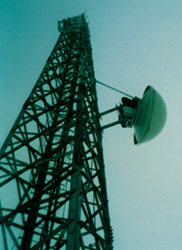
Several years have passed since Magti GSM began its operations, and already its network covers most of Georgia's populated territory. Today, the number of Magti GSM subscribers exceeds 200,000. The company began with seven base stations (BSs) in Tbilisi and one in Rustavi, adding new BSs stage by stage. MagtiCom was the first to provide coverage to Kakheti, Racha, Samtskhe-Javakheti, Svaneti, Gudauri, Bakuriani and Kazbegi.
Proper coverage of rural territory by the cellular radio
communications network is not an easy task, especially in a mountainous
country like Georgia. We have many highland settlements located at a considerable
distance from one another and isolated from the central regions of the
country. That is why the selection of the proper location for any BS requires
a thorough survey of the terrain. Besides, full coverage of the area cannot
be achieved without the availability of access roads, electric power supply
and reasonable maintenance. Considering these, alternative site selection
may differ significantly between various stations, as each requires an
original solution.
This is one side of the problem. The other important obstacle
is the accessibility of base stations by means of technical network elements.
This is a key factor in most cases when considering alternative sites for
highland base stations.
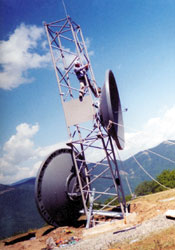
Base station access or its connection with the main switching
center in the GSM system is provided by means of 2,048 Mbps digital transmission
paths. This is a European standard known as E1. In general, such paths
can be arranged on the basis of previously existing as well as specially
constructed transmission systems. However, the only way to access scattered
highland BSs is by using specially designed microwave links. The MagtiCom
mobile communications network is fully self-sufficient, with its own digital
microwave systems that include microwave links arranged from Tbilisi to
West and South Georgia, Kakheti, Kvemo Kartli and a number of other directions.
It is already possible to arrange microwave branches towards individual
base stations from these links. But certainly the arranging of each branch
varies in terms of difficulty. Fundamentally unequal conditions for
radio wave expansion are created both by the mountainous terrain of Georgia
and by the diversity of weather conditions in the regions. For this reason,
arranging of each microwave link demands an individual approach. The distances
between the base stations within the network vary significantly: some stations
are only one kilometer away from each other, while others are separated
by dozens of kilometers. The distance between Kojori and Gudauri is 92
km. The longer the distance between the base stations, the more difficult
it is to provide reliable connection in conditions of abrupt weather
changes.
In general, to achieve stable microwave connection between
two stations, a direct line of sight is needed, which is often unachievable
in highlands. The solution is a passive repeater on a specially chosen
location between the base stations. This method allowed the expansion of
MagtiCom's coverage area to Akhalkalaki, Sarpi, Kazbegi, Pasanauri, Mestia
and Shovi.
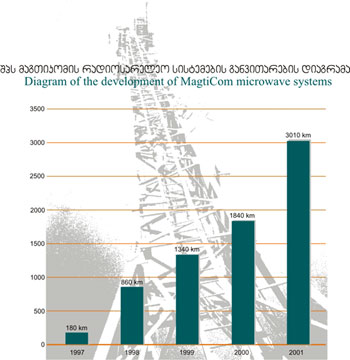
Today the digital microwave connection network of MagtiCom is the most extensive in Georgia, covering almost the entire territory of the country. The total length of microwave links within the network exceeds 3,000 km and has large reserves with respect to the number of E1s. As a result, it fully meets the demands of Magti GSM base stations (considering its development prospects), while at the same time serving as the medium for information exchange for data transfer systems with various purposes. This will be of great interest to those organizations whose activities require full coverage of the territory of Georgia. MagtiCom digital paths may be used for broadcasting TV programs in the regions, access to Internet, banking and customs services, and for special TV service networks and systems.
Professor Givi Murjikneli
Technical Manager of MagtiCom