KOBA MIRESASHVILI Chief of Environmental and Sanitary Control Service of MagtiCom
Our readers have shown a keen interest in the
publications dealing with cellular communication and the related sanitary
safety issues. Numerous letters addressed to the MagtiCom Sanitary Service
is a proof of this interest.
The majority of questions we
receive from our readers concern cellular base stations. This is a broad
topic exploring a number of problems. To make this article simple and concrete,
we decided to present it in the form of questions and answers.
Q: Is there any hazard related to cellular base stations? What do
scientists think?
Scientists from many different countries (Petersen, Thasandott,
Maulder, Hant, etc.) have worked out a common approach to the question
and believe that the operation of a base station is absolutely safe, provided
all the necessary requirements are met. These requirements are as follows:
· modeling the level of electromagnetic field prior to the installation
of a base station;
· measuring the intensity of the electromagnetic field at the
moment of phasing in and throughout the operation of a base station;
· compatibility of the intensity of the electromagnetic field
to the statutory sanitary norms at any stage of operation.
We should note here that the Georgian legislation (Decree
#297/n of 16 August, 2001 by the Minister of Labor, Health Care and Social
Protection of Georgia “Of the Approving of the Norms of the Qualitative
State of the Environment”) sets forth all the required measures to be taken.
Moreover, in Georgia the maximum acceptable level of intensity of the electromagnetic
field is 10 mW/cm², which is much lower than the corresponding parameter
in the United States and the EU countries (470 mW/cm²).
Q: What is a cellular base station? Does the “base station” mean the main station?
First, let us differentiate the terms: mobile phone - also
referred to as a mobile radio station, a cellular phone or a portable phone
- is a low-power one-channel transceiving radio. “Mobile” means that such
a transceiver can move in space together with its user or be built into
a vehicle, a train or an aircraft and used when those means of transportation
are in motion.
A base station also known as a cellular communications
station, a cellular radio station, or a cellular radio knot) is a low-power
multi-channel radio transceiver. The name “base” means that such a transceiver
does not move in space. It is located in a specially chosen place to create
the so-called “coverage area”. To better understand the meaning of a base
station let us discuss its place in the system of cellular communication
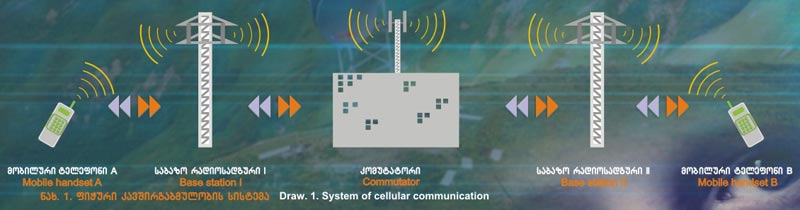
(Draw. 1).
As is seen from the drawing, when the number of a mobile
addressee (B) is dialed on a mobile handset (A), the latter uses a radio
signal to establish connection with the base station (I) in the coverage
of which it presently is. The signal from the base station is transferred
to the Main Switching Center (MSC), which establishes the location of subscriber
B and sends a signal to the appropriate base station (II). The addressee
receives a radio signal directly from base station II.
During a telephone conversation the radio signal passes this track in a two-way direction. Thus, a base station is a connecting link between the mobile user and the MSC. The quality of cellular communication greatly depends on the coverage and the capacity of a base station.
Q: What are the main criteria in selecting the location for a base station? What should be the shortest distance between a base station and a residential house?
When choosing a place for a base station, special attention
is paid to the altitude at which the antenna is mounted. That is why in
populated areas a sufficiently tall building or other high installations
are chosen, and special towers are mounted in non-populated areas to achieve
optimum coverage and low indices of intensity of the electromagnetic field.
As for the distance between base stations and residential
houses, in the US, EU and CIS it is determined by the demand placed on
any base station operating within the range of radio frequency that the
intensity of electromagnetic field generated by radio antennae must not
exceed the maximum acceptable level. That level is 10 mW/cm² in Georgia.
The sanitary safety of the population is contingent on this parameter and
not by the actual distance between a base station and a residential home.
Q: Are there any limitations placed on locating base stations in
“the most vulnurable areas”?
(These include residential homes, schools, nursery gardens, hospitals,
etc.)
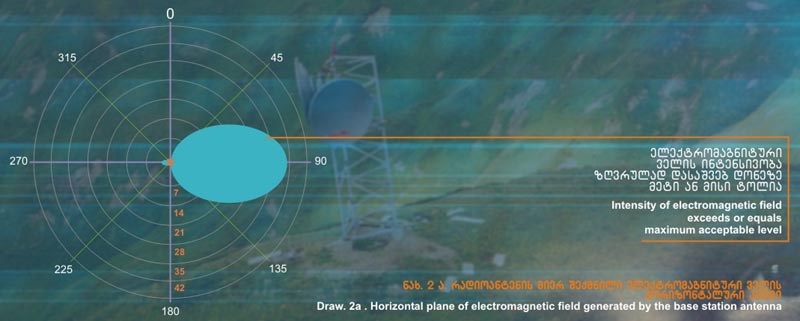
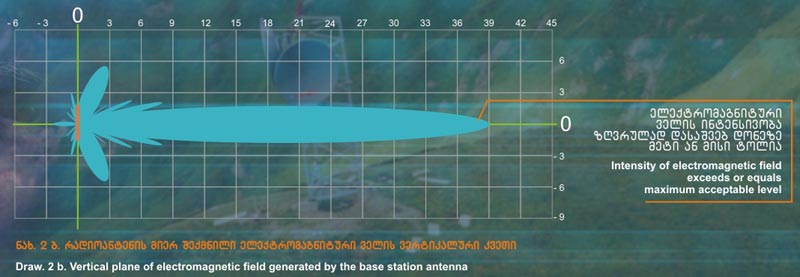
No. The sanitary norms for base stations operating within the radio frequency range do not set any limitations regarding to the location of an antenna unless the intensity of electromagnetic field exceeds the maximum acceptable level. As for the idea that a base station should be as far as possible from sensitive areas, it is entirely unfounded. The matter is that the intensity of electromagnetic field generated by the base station antenna is decreased much more rapidly when moving away from the antenna in a vertical direction (either up or down) than in the horizontal plane along the axes of electromagnetic field (Draw. 2a and 2b).
This is confirmed by instrumental measurements. The influence of the electromagnetic field on people (residents, employees, students, etc.) in a building with a BS antenna on the roof is much weaker than it is on people several hundred meters away. However, in both cases the intensity of electromagnetic field does not exceed the maximum acceptable level.
Q: How is the compatibility of the intensity of electromagnetic field generated by a BS with the statutory norms determined?
This can be determined either by calculation or by measurement.
Both methods are based on the physics of RF radiation.
Calculation requires knowledge of such technical characteristics
of BS transmitters and antennae as the frequency range, transmission power,
diagram of antenna direction, altitude of antenna location, inclination,
etc.
Measurement requires expensive state of the art equipment.
The State Sanitary Inspection carries out instrumental
measurements of the intensity of electromagnetic field with such equipment
in order to constantly monitor the sources of electromagnetic field. When
making these calculations or measurements, one should take into consideration
the possible existence of other sources of RF band, because their signal
will be added to that of a base station, thus increasing the total intensity
of the electromagnetic field.
Q: What permits are needed to construct and operate a base station?
When a site for a base station is chosen, the area is either
rented or purchased in accordance with the relevant regulations, an estimation
of construction and sanitary parameters is elaborated.
These estimates are submitted to the competent agency
for review, following which permission for construction is granted.
The Inspectorate of State Supervision over Sanitary
Norms and Rules at the Ministry of Labor, Health Care and Social Protection
of Georgia is responsible for setting the necessary sanitary-safety and
construction limitations.
When the construction is completed and the BS is put into
operation, the Inspectorate of Sanitary Supervision conducts an instrumental
measurement of the electromagnetic field. If the results of the measurement
fully satisfy the sanitary norms and rules, a relevant document is issued.
If the results of the measurement are not satisfactory, the characteristics
of the BS antenna are changed or the antenna is dismantled.