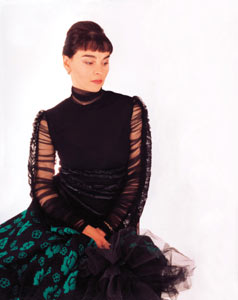
She found herself in the theatre without being
aware of it. She found her way to the Theatre
Institute by asking passers by to show her
the way. Everything happened at the expense
of fear and stress… Today it was her that we paid a
visit to the Rustaveli Theatre actress,
Nino Kasradze.
- Nino, the appearance of your generation on the stage
coincided with a rather tough time. One can say that it was a somewhat
“inappropriate age”. Who was your heroine at that time, what were her values
and what message did she have to communicate to her audience?
- I don't know how my “heroine” managed to live through
this “age of inappropriateness” and pass this ten-year test. Years are
still necessary in order for my heroines to demonstrate in an “orderly
arranged” situation whether they have survived or not and whether we have
managed to establish ourselves as a generation. It is not false criticism
that makes me speak like that. The themes of the day have changed completely
and our attitude towards reality and our profession has also changed. At
the beginning of my career when I was working at a terrific pace, I was
not even thinking of what I was saying or why I was appearing on the stage.
The situation was so difficult that the act of appearing on the stage and
attempting to communicate a message equalled bravery. The vacuum was so
big that anything could have been said and everything sounded important:
the appeal to anarchy or the struggle against anarchy. Now it is much more
difficult, the responsibility is much greater. One must think, exercise
a lot of caution and demonstrate a great deal of professionalism. People
are tired of spontaneous actions, ingenuous naivety, the “naive” actions
typical of youth, proving that it does not matter if we do not possess
acting technique and knowledge because we are driven by earnest emotions.
The time of terrible and cruel professionalism is coming. You won't be
able to achieve anything solely by emotions. Now it will become clear which
lessons each of us has learnt, what kind of a “school” each of us has “created”
for ourselves.
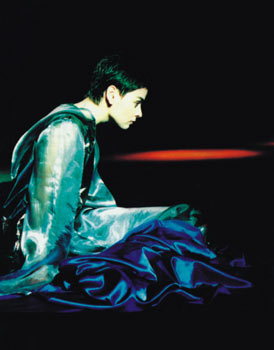
- What do you mean by new themes?
- The eternal themes delivered in a new form. A savage
form does not justify itself today. Nostalgia for a normal way of life
and “well-packaged”, warm relationships have emerged in society. It is
necessary to overcome chaos; continuous chaos is exhausting.
- What do you consider a savage form?
- For instance, even a “Sichuan” type and myself in “Sichuan”.
I am strongly convinced that this stage has gone. Sturua is constantly
searching for something new; he has an ingenious skill of perceiving the
contemporary. He does not need to travel for that. He finds and sees new
methods and forms immediately…
Today everything is speeded up. The pace of quest, living
on the stage and artistic thought are all accelerated. When we were working
on “Twelfth Night”, Sturua required a new spoken language from everyone.
This sent us into shock and all of us found it very difficult. He was telling
me: Now it is not the time for “relating” a story in the old way, nobody
is interested in that. Everything should change inside; a new motion, a
new impulse and a new charge should originate from within. Almost as it
happens in the movie “Run, Lola, Run” where the action and the plot “compete”
with each other and “overtake” each other. In this speedy run there is
one serious danger, though: the message to be conveyed and the form should
not seize you to the extent that you forget the main thing. A real spiritual
purity is required for that.
- The new challenges must have made you think of the necessity
of the school…
- The heroine of the 90s was so frank; she was willing
to use herself up so much… And she did get used up. This was followed by
confusion - a peculiar crisis… For three years, between the roles in the
“Snake Woman” and “Twelfth Night”, I did not play a single role. However,
the role in the “Twelfth Night” helped me to leap fifteen steps forward
making me appreciate the new sense of craftsmanship.
First of all, I was lucky to work with very good actors
and, secondly, I was seized with the desire of learning. I wanted to prove
to myself and to everyone else that I was capable of overcoming such complexities
as well. This was the first case when I could say: I made a decision and
I made it happen. Prior to that, throughout many years I kept acting so
that I had no clue what emerged from what. At times I read things about
my role in a critical article that surprise me. For instance, I have read
in Victor Gulchenko's article that in “Macbeth” I am holding a coat as
if it were a child that I am rocking in a cradle. I have never realized
that.
- What was the reason for such “lack of knowledge”?
- The same “naivety”, I guess. I was 24. I managed
to develop some of Lady Macbeth's qualities only with Sturua's help. Now
I look back at myself with surprise how much impudence I should have
had when I said: “Come, you spirits that tend on mortal thoughts, unsex
me here… Come to my woman's breasts and take my milk for gall…” - It would
be the same if I had thrust my little Salome on the ground. I am sure that
today I would not be able to do all that so thoughtlessly, without experiencing
a deep perception of what I ought to do. One cannot play this role relying
solely on emotion. When I say this, I am by no means belittling the play
and my part in it. I wouldn't be able to do that anyway only because this
was Sturua's decision… I perform the whole monologue in three minutes and
the audience does not even have the time to appreciate it and come to its
senses. It is through pauses that you are trying to pretend to spectators
- says Sturua. Swiftness has a different loading, it attacks the audience
differently and you, you are not thinking yourself - you are forcing the
audience to think.
- What you are saying implies the existence of a certain
technique, a certain method. One might say that it is the theory of a certain
emotional attack, a shock, an assault. And now you are gripped by the desire
to switch to a more rational, “calm” theatre…
- Most important is the fact that Sturua's message has
also changed. If the Macbeths used to interface on the stage for three
hours and had plenty of time to settle their problems, in Sturua's theatre
of today, which is more collage-like, everything must happen in a second.
In “Twelfth Night” and in “Hamlet” everything should be handled as a filigree
work, simultaneously retaining this “attack”. All that has nearly turned
me into a disabled person in “Twelfth Night”.
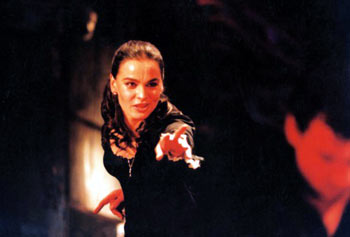
- This means that the work is accompanied by a psychological
stress …
- Didn't I say I was on the verge of turning into an invalid?
Viola was supposed to be a strong and mysterious woman. Some kind of big
mystery originates from her. Viola does not want to put female clothing
on any more and she must deny her own self if life is like that, if everything
happens upside down. She is the child of the XXI century and she takes
everything upon herself. All issues are brought up in this play: those
of women, men, men and women, war and peace; simply emancipation…
It is again at the expense of Georgian talent that the
actor of the new age could be created. If you follow Sturua, if you feel
and guess what he demands from you, what he can give you…
They say that Zaza Papuashvili, Levan Berikashvili, Amiran
Amiranashvili and Goga Gvelesiani are very good in a new performance (which
I have not seen) ….
- A drastic change has taken place in your life. What experience
have you gained from that?
- Patience is something that my child has taught
me. I must be patient in the morning, I must be tolerant in the evening,
I must be enduring at night… I don't sleep at all. She is very emotional
and extremely curious. Her emotionalism is not surprising, though - she
takes after her parents.
- It is believed that an actor should be prominent in ordinary
life as well.
- Of course. I am a very disorderly person. I told myself
recently: Nino, if you go out like that in the street, your actress' life
shall be over! An actress must be distinguished by the fact that she is
an actress. I am striving to achieve that but I've had no success yet.
Perhaps I'll be able to make it by the age of 50. Perhaps I'll manage to
change to such an extent that everyone will realize that I am an actress.
Do you know what the Armenians said when they were watching my trial shots
and approved me for the movie? - She is nothing much in life but she looks
good on the screen.
- I can set your mind at rest and tell you that in this
case the taste of Georgians and Armenians does not match, it is different
indeed!
How did the idea of becoming an actress come to your mind?
- I simply found myself in a theatre without being
aware of it. My mother and I did not even know the address of the Theatre
Institute. We kept asking on the way; it is embarrassing to acknowledge
it. I hadn't prepared for it. Everything happened at the expense of terrible
fear and tremendous stress. You had to put a tight black tricot on an undeveloped
body, go out onto the stage, play an etude, read a fable… I felt
awkward all the time. The first of September was also a real torture. What
will they say? What will they think? What am I like? What if I go there?
What if I sit down here? But at the same time, there is also a faith in
yourself, which lives somewhere inside of you. You start making friends,
someone is fond of you, you start getting somewhere. Before that I had
drawn up a list of people and against the name of each of them I used to
put pluses and minuses depending on the success of my communication with
them. They used to tell me I resembled a big, strict woman. I had myself
locked up in terrible armour. I lived like a true Spartan.
By the way, I have noticed that whatever I put a lot of
energy into, I achieve a good result. I have even developed a special system
of strengthening my will power without mastering any particular technique,
though. All this happened to be within me. This method has not proved to
be correct on the stage, however, giving me a poor result. Everything was
set within limits, I have lost my spontaneity. I have realized that an
actor does not need any psycho-energetic exercises. If you undertake such,
you will turn yourself into a lonely, solitary warrior building a deliberate
isolation around yourself.
- There is much of mythology and mystery in your repertoire.
Have you ever sensed that?
- Of course I have. Sometimes I didn't even know what
it was. In “Macbeth”, for example, I managed to avoid it easily and you
know, apparently, Sturua has one extraordinary quality. He takes everything
negative and mystical and places it on himself, protecting the actor. This
was also the case with “Macbeth”. I recall once someone reprimanding us
for not being able to perform well enough. I answered to that: It was not
that I was unable to perform well, I did not perform at all. When the level
of frankness is a thousand percent, an awful thing might happen!
There are also other plays where the experience of mystery
is very sharp as well, for example, in “Lamara” or “Twelfth Night”. There
is something peculiar about the stage: something materializes on it and
then it accompanies you all the time. Almost everything that I have performed
well and wherever I have managed to “open up”, has become my destiny. Experience
tells you not to “open up” like that, because such openness deteriorates
the quality of your work. When I referred to the “savageness” earlier,
this is exactly what I meant.
- The spectators watch the play on the stage. Is any “performance”
played for the actors?
- There is one actress who notices everything from the
stage: your mother, your uncle, your aunt - she can see everyone in the
stalls. I can't. I detest packed auditoria and I love it when the audience
is not numerous. In a packed auditorium there is almost no room left for
sound and emotion, there is nowhere you can address your message. You can't
see the faces; some kind of a common mass is resisting you, suffocating
you. Everything gets back to you instantaneously and bounces badly off
you. When the audience is not numerous, you are seized by an absolutely
different sensation - that of breadth and freedom. It is a real spectator
who even puts up with the poor conditions to have a chance of seeing the
play.
What else do I usually look at? Well, I am a very
frequent “dead body” on stage. I lie on the stage, look around myself and
watch what is going on. How beautiful the stage and the auditorium are!
I have my angels of different colors. Do you know what else I also love
and what amazes me? At the very top, from the sides of the circles people
often hang down and I keep wondering what they can see from there. I recall
that this was how I watched Calderon and the only thing I could see were
Zaza's outstretched arms. In “Lamara” I am coming down and from there I
can see what the audience is doing. They don't know that I am supposed
to descend and I keep thinking: Now you will see me! - All of a sudden
they notice me and everybody starts to look in my direction: first the
upper circles and then the stalls. I have the right to watch them, because
I am a stranger - “an extraterrestrial”. People resemble sparrows and the
stage looks so beautiful - so open and wide.
- What is the magic of the theatre? Does a religious feeling
seize the actor?
- That is a very intimate question. Since an actor is
a human being, he should believe in God. In my opinion, being religious
means obeying the rules and customs. It is very difficult for an actor
to be a truly religious person. If you are an ardent believer, you won't
be able to stay on the stage because a host of taboos exist there, which
you are obliged to break. This is a terrible dilemma in my life;
I suffer a lot from that. There are people who are able to combine such
things. They believe that one does not impede the other. I cannot agree
with that. Everything has a rule of its own - so do both the theatre and
religion. In the theatre you take on a huge responsibility. Once Gogi Kharabadze
gave a very good response to this question: I will never fully transform
into the role I play because in such a way I will not oppose the church;
I am an interpreter and I always retain my “ego”. When you get into someone
else's skin, you transform yourself into a different person and by doing
so you break the regularity. I shall always stay at the threshold beyond
which someone else's soul gets agitated. - I fully agree with Gogi on that.
An actor needs talent and acting technique in order not to cross the prohibited
border, to avoid the story of Doctor Jekyll and Mr Hyde. This is where
the church comes in. It safeguards us and cautions us from that. That is
why I like it when the producer's idea serves a good cause. The sense of
responsibility in me grows with age. I have never been a prude, I have
never lacked boldness. But now, I keep thinking at times whether it would
be possible to do without all this? That is why when I watch movies or
some plays, a thought occurs to me more and more often telling me that
I would not be able to play in this performance.
- The contemporary age sends new unusual challenges to
actors such as advertising, for instance.
- Good advertisement is real art, indeed. We have
also attained certain achievements in this area - humor and brevity. However,
I am very careful with this sphere and I truly have no intention of accepting
all the offers. I can't even imagine what I can advertise. Magti is an
exceptional case. When I was shot in the Magti advert, there had been almost
no experience in this business. Therefore, we had to work very hard. We
had to observe the limits and the sense of proportion and find an appropriate
format. Advertising has yet another peculiarity - it is truly public and
universal. We were staying in Likani for a holiday. My husband had to speak
incessantly on his cell phone. It seems that the other holiday-makers also
noticed that. A little girl ran up to me and said: Hasn't the story of
your advert come true?!
A small jubilee film followed this advert. These shots
turned out to be much more interesting and manifold. We filmed in the sea
and in the mountains. The crew was also splendid. They were trying to develop
a creative approach to their job. I would again reiterate that I view advertising
very cautiously and I will probably refuse to advertise anything else.
Cinema provides much ampler opportunities. But, unfortunately,
nothing much is being done in our country in this respect. It has not even
been possible to show my work in Chaldranian's movie “The symphony of silence”
in Georgia. And in the meantime, this movie has been presented at numerous
prestigious festivals. My sister, who lives in France, told me that a huge
poster displaying my picture was displayed at Saint Michelle. I do hope
that by the end of the day Georgians will also be given the opportunity
to see this movie.