It is when blood ignites like dynamite and when art is
in the genes, the rhythm follows the heartbeat and you don't wipe the tears
because you are not ashamed that you're crying!
When speaking about the Sukhishvilis, the margin between
genuine admiration and false pathos is slender, for this form of Georgian
dancing has become a national heritage and every contact with it requires
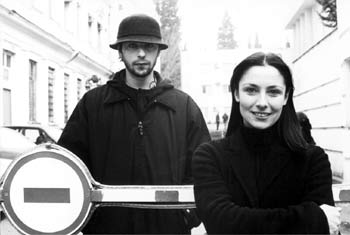
great delicacy. Even more so should the junior Sukhishvilis, Nino and Iliko
carry on the legacy they have inherited with particular courage and responsibility.
In the offstage dust
“We have grown up in the dust of
the wings,” says Nino cheerfully with a peculiar pronunciation of hers.”
I don't know whether no one could stay with us at home, or because of our
own curiosity but since early childhood we have attended every concert.
Iliko and I used to stand and watch the dancers. We loved and admired dancing
immensely and it was so organic to me that I have never become bored with
it. Just imagine, several months ago we gave 74 concerts in the United
States and I attended them all!
Apart from the wings, they were
in the shadow of the great Iliko and Nino. In their childhood, as every
offspring of great ancestors, they were driven by a sense of protest -
they wanted to do something different and no less important. Perhaps that
is why Nino specialized in ceramics at the Academy of Arts and Iliko graduated
from the faculty of stage eurhythmics of the Central Academy in Moscow.
Time passed, however, and this “inhibition” gradually disappeared. Both
of them realized that their life was inseparably linked to the Sukhishvili
dance company and that the National Ballet was their only vocation.
“My 'academic' background
has turned out to be very helpful today. I was fortunate to have had the
opportunity to work as Mr. Soliko Virsaladze's assistant and master the
art of creating stage costumes. I help Iliko and try to invent something
new. I suggested, for instance, that the girls dancing “Juta” should wear
shepherd's caps with little bells… So costume design is a familiar and
interesting work for me.
Iliko has an exquisite ear for music.
He can play every kind of musical instrument and is a professional dancer.
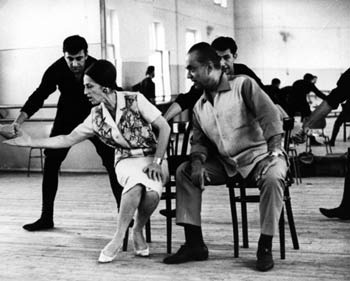
He has been on the stage since he was eleven and his grandfather, the great
Iliko has watched him dance. His desire to follow his own path in life
has made him a highly professional choreographer. Today he is the
senior choreographer of the company.”
With unusually piercing green eyes
on a tanned face, Iliko jr. has acquired all the best qualities of his
parents and grandparents. He gets annoyed if disturbed when working and
at rehearsals his inexhaustible energy submerges everyone like a wave.
Nino finds speaking about her brother embarrassing. “Not because he is
my brother,” she says apologetically. “You know, our grandfather was the
leader of the company, our grandmother - the chief choreographer and both
of them were great dancers. Iliko has absorbed these qualities, which is
very rare indeed. He does not only dance, but he also stages the dances
professionally, being simultaneously engaged in musical arrangement. He
is endowed with an unlimited creative imagination. He always comes up with
new ideas, which he realizes successfully… Grandmother used to say: It
is good when a dynasty really exists and lives up to expectations. It is
not often the case though, but in Iliko's case the dynasty has really proved
to exist.
In the nineties when still studying
in Moscow, Iliko was engaged in staging shows in newly opened nightclubs.
He has also worked at the Taganka Theatre and with Sharoev at the Variety
Theatre. He has continued his cooperation with Mauritz Van Hill, the Amsterdam
Dancing Theatre manager to this day. In 1994 he staged the “Black Sea dances”
and last year the “Caucasian dances”. Two or three rehearsals and the performance
or a show outline is in place. Like all gifted creative personalities,
Iliko does not like to speak about this work; he does consider it serious.
He lights up, however, when his projects are referred to, particularly
if the word “folkotheque” is mentioned…

Moving forward towards the past
Last year a surge of bewilderment
swept across middle-aged and elderly Tbilisi society when the junior Sukhishvilis
presented their new performance in the Philharmonic Hall. The first classical
part of the programme was followed by strange developments in the second
part - standing next to the men, women performed male steps, moving their
feet at a breathtaking pace. The audience's first reaction was association
with the River Dance: They are merely following the trend. They have defiled
the legacy of their grandmother and grandfather, choosing to imitate the
Irish national ballet.
“I get annoyed when we are compared
to the River Dance, although I am not surprised at the reaction of general
public at all. When you deal with the national heritage, it is dangerous
to cross the border between greatness and indecency. The Georgian
National Ballet company cannot exist using solely the forms of the past.
Like every living organism, it needs to develop and keep in line with the
evolving times. That is why this “second part” of the programme was produced.
In our century women have become equal to men both socially and politically.
Why can't one have this reflected in a dance?! This is what the new programme
does - the woman has an active role in it, equal to the parts performed
by men. This is a requirement of the time. Doesn't a dance portray the
history of a nation through movement? It is history that is articulated
in a language understandable to the audience at the same time as being
the reflection of the past, present and the future! As far as the River
Dance is concerned, I have seen them a few times on television. They have
an excellent promotion, good management and undoubtedly a masterfully structured
programme. I am not sure to what extent their dances are “Irish”, they
look more a mixture of the step, the gypsy and the Russian dances to me.
Our programme is fundamentally Georgian, without any “admixtures” whatsoever.
The only thing that the River Dance and we have in common is popularity,
but here also we have outstripped them - they have been “shining” for ten
years only whereas the Sukhishvilis have “shone” for sixty! And let the
guardians of the sacred national heritage have no fear - nobody will take
better care of it than we will and nothing shall endanger the national
pride! We are custodians and developers at the same time.”
During the American tour the Sukhishvilis
had a full house every night. After the second or the third dance, the
wave of the energy mounted in the audience resulting in a near frenzy at
the end. Demands for repeated performance did not stop and the music played
by the orchestra between the dances - the newly arranged theme of “Gadi
Gamodi Gutano” by Chabuka Amiranashvili, became a hit. The difference between
the first and the second parts of the performance did not go unnoticed,
and the ranks of the Sukhishvilis' old admirers were filled with teenagers.
The same phenomenon is observed in Tbilisi today. The generation of grandmothers
and grandfathers has “rejuvenated” and, as some claim, is being replaced
by nihilist youth, for whom, according to them, nothing matters including
national values. But this is, of course, not true. Genes determine the
shape of our mentality and existence and when the “Khorumi” rhythm matches
the beating of the pulse, the desire to provoke teenagers disappears and
one gets seized with a sense of pride!
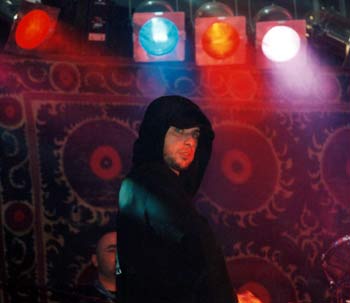
This made Iliko jr. create the “Assa
Party” - a club version of the Georgian national ballet known as a “folkotheque”
which is a successful attempt at shifting it to the discotheque. And just
like a black man follows naturally the rhythm of rap so did the “Noa Noa”
and the Ajara Music Hall audience follow the rhythm of the Sukhishvili
dancers dressed in sports clothes and the room was filled with boundless
energy.
“I know I'm losing my voice,” Iliko
jr. was saying when I caught up with him between rehearsals. “It is almost
a year since the idea of the “folkotheque” appeared to me. Vaniko Tarkhnishvili
was very helpful in realizing this idea and Irakli Chachkhiani helped me
with its musical arrangement. I am happy with the result because I was
convinced that the youth, club version based on national motives has worked
and, in return, I got from the audience just what I was expecting to get.
There is still a great deal that needs to be improved, particularly the
movements need to be simplified so that people at the discotheque are able
to repeat them… I am also promoting the idea of the “Assa Party” theatre
version… The most important thing is that your art must be truthful. It
should not be fake, a surrogate. If you are sincere, it will work just
as the “folkotheque” has done.
Back towards the future
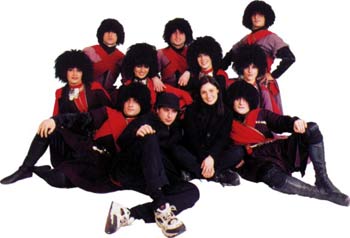
“I do hope that the Caucasian folklore
will gain as much popularity in the west as the Spanish and Oriental motifs
have. Of course, this requires “promotion” and a lot of money. I have become
convinced that in show business money, although very important, is not
the main thing. Regardless of everything, our company continues to exist
successfully and the realization of new projects will allow us to maintain
our troupe which is currently supported by a state subsidy. And let nobody
think that we have profaned the relic! It is just the contrary, in this
high-tech age we have breathed new life into it.”
History repeats itself: the programme
known as classical in our days was the product of great Iliko's free fantasy
in the 1940s and was presented to the totalitarian regime under the cover
of “folk dances”. Iliko Sukhishvili was indeed a smart man. Having refused
the authorship, he managed to develop avant-garde ideas through national
dances. But all this did not pass smoothly. I recall my grandmother referring
to the harsh reaction of the high officials of that time - the Sukhishvilis
were censured and were proclaimed desecrators. There was an uproar when
“Khorumi” was first staged and the dancers started moving in a line? Today
“Khorumi” is a classic and a monument to great Iliko. Previously three
men used to perform this dance and it was known as “Samaia”… Today's “Samaia”
is the fruit of Iliko's free will - it is a vivification of the Georgian
fresco painting, the revival of the Queen Tamar's image. Or take red chokhas
and hats with little bells in the “Khanjluri” dance. In the forties it
was denounced and criticized as dancing rap under Georgian tunes is today…
What else shall I recall?” Nino goes deep into thought. “Women wearing
special Ajarian bands on their heads in the “Ajaruli” dance was daring
beyond any limit because women used to dance in veils. When Nino Ramishvili
put on a white chokha and performed a drop and whirling on her knee, you
can imagine how everyone reacted to that! It had nothing to do with female
movements! And we are criticized today for the women-dancers wearing shortened
dresses and performing male steps with their feet in the “Juta” dance?
Over the course of these years the line between the creative imagination
of great Iliko and Nino and the truly national elements has disappeared
and what used to be clear “impudence” for the forties, has become generally
accepted as classic these days. Iliko jr. and I are doing exactly the same
thing today that our grandparents did in the forties.”
The juniors are building on the
heritage and creating the future of the Georgian National Ballet, which
in the middle of this century will too, perhaps, become a classic.
For Nino and Iliko the routine of
everyday life is the basis on which a deep sense of patriotism is cultivated
and that will always protect their creative endeavors from falsehood and
deceit.
IRA CHELIDZE